
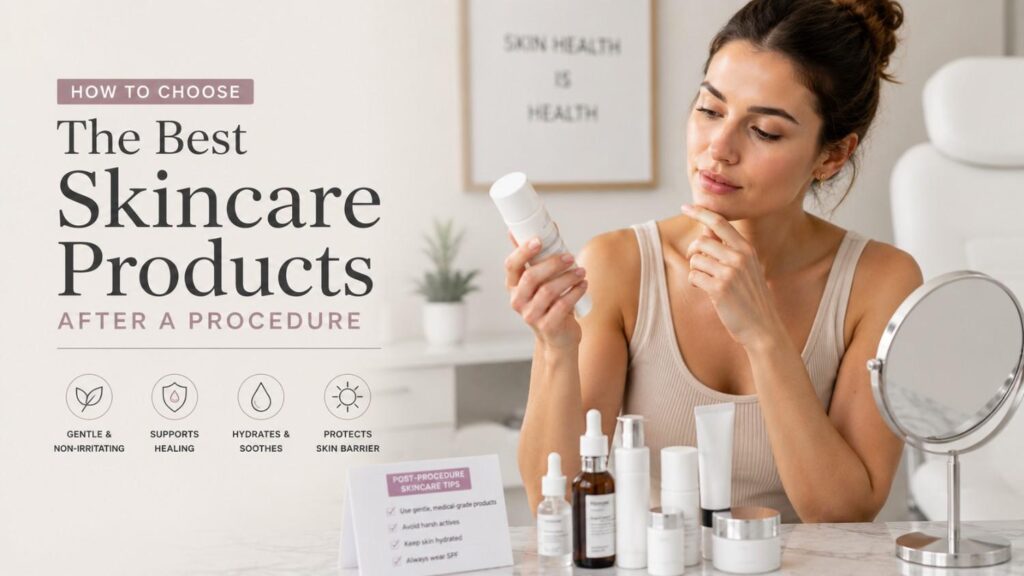
How to Choose the Best Skincare Products After a Procedure
Skin often behaves differently after laser treatment, a chemical peel, microneedling, injectables, a biopsy, or minor surgery. Products that felt comfortable before treatment may suddenly sting, worsen redness, or interfere with wound care while the skin is recovering. Learning how to choose the best skincare products after a procedure therefore begins with understanding the treatment performed, the condition of the treated surface, and the written instructions supplied by the clinician.
The safest post-procedure routine is usually simpler than a normal skincare regimen. Instead of layering multiple serums, exfoliants, brighteners, and anti-aging products, most people need only carefully selected cleansing, moisturizing, wound-care, and sun-protection products. However, the correct products and timing are not identical for every procedure. Intact skin after an injectable treatment has different needs from peeling skin after a chemical peel or an open biopsy site covered with a dressing.
This guide explains how to evaluate cleansers, moisturizers, ointments, sunscreens, packaging, and ingredient lists without relying on marketing claims alone. It also outlines common ingredients that are often paused, practical questions to ask a provider, procedure-specific considerations, warning signs, and a gradual method for restarting a regular routine. The information is educational and does not replace instructions from the dermatologist, surgeon, nurse, or licensed professional who performed the procedure.
The Safest Core Routine
The safest core routine begins with the exact products and timing listed in the aftercare instructions. Once cleansing is permitted, use lukewarm water and a mild, non-abrasive cleanser, applying it with clean fingertips rather than a brush, sponge, or textured cloth. Pat the area dry with a clean, soft towel unless the provider recommends air-drying or a different method. Avoid rubbing because friction can aggravate tenderness, lift healing skin, or disturb a treated surface.
Next, apply the moisturizer, ointment, or dressing recommended for the procedure. A plain cream may be suitable for intact, dry skin, while petroleum jelly or a prescribed wound product may be required for a biopsy or resurfaced area. These products are not interchangeable, so follow the specific plan rather than choosing solely by texture.
When sunscreen is approved, use a broad-spectrum SPF 30 or higher that feels comfortable and does not sting. Until then, rely on shade, protective clothing, and a hat that does not touch the treatment site. Keep the routine stable, introduce only one new product at a time, and record any reaction so the cause is easier to identify.
What to Pause During Healing
Products that intentionally accelerate cell turnover, exfoliate dead skin, dry acne lesions, or create a noticeable tingling sensation are commonly paused during recovery. This group often includes retinoids, glycolic acid, lactic acid, salicylic acid, exfoliating enzymes, benzoyl peroxide, abrasive scrubs, cleansing brushes, and strong low-pH vitamin C formulas. Pigment-correcting products, prescription acne medications, and fragranced botanical blends may also need a temporary break.
The appropriate pause period depends on treatment depth, the condition of the surface, the person’s baseline sensitivity, and whether the product is prescription strength. A light treatment that leaves the barrier intact may require only a brief interruption, while deep resurfacing or a medium-to-deep peel can require a substantially longer recovery period. For this reason, a universal timeline such as “restart after three days” is not safe for every reader.
Do not restart an active simply because visible redness has improved. The skin may still sting easily or remain vulnerable to irritation. Wait until the provider confirms that healing is adequate, then reintroduce one active at a reduced frequency. If burning, peeling, itching, or prolonged redness returns, pause it and seek procedure-specific guidance.
Why Post-Procedure Skin Needs a Different Routine
A cosmetic or medical procedure can temporarily alter the skin barrier, inflammatory response, hydration level, blood flow, and wound-healing needs. Even treatments considered minimally invasive may leave the skin more reactive than usual. As a result, a familiar cleanser, moisturizer, sunscreen, or serum can feel uncomfortable immediately after treatment despite being well tolerated before the appointment.
The degree of change depends on the procedure. Laser resurfacing and stronger chemical peels may remove or disrupt part of the outer barrier. Microneedling creates controlled channels in the skin. A biopsy or minor surgery creates an actual wound that may need ointment and a dressing. Injectables usually leave the surface largely intact, but swelling, tenderness, bruising, and instructions to avoid rubbing can still affect product use. These differences explain why a single “post-procedure kit” cannot be ideal for every situation.
Recovery also changes the goal of skincare. A normal routine may focus on acne control, brightening, texture, pigmentation, or anti-aging. During healing, the priorities shift toward protecting the treated area, reducing avoidable irritation, maintaining appropriate moisture, and preventing unprotected sun exposure when sunscreen is allowed. Understanding this temporary shift helps readers make practical choices instead of trying to continue every step of their previous routine.
Barrier Disruption Varies by Treatment
The skin barrier is not affected equally by every procedure. Ablative laser resurfacing, stronger peels, and surgical wounds can create a visibly raw, peeling, crusted, or open surface. These situations may require prescribed cleansing methods, regular ointment application, dressings, or specific wound-care instructions. A standard facial moisturizer or cosmetic serum may be unsuitable until the surface has closed and the clinician approves routine skincare.
Microneedling and microdermabrasion generally affect the barrier differently. The skin may look intact but feel warm, tight, dry, or unusually sensitive. Products containing alcohol, fragrance, acids, or other active ingredients can sting more than expected. Non-ablative laser and light treatments may cause redness or swelling without producing an open wound, yet their intensity and recovery time still vary.
Injectable procedures usually preserve most of the outer barrier. Nevertheless, puncture sites, bruising, tenderness, and provider instructions about pressure or massage must be respected. A product may be chemically gentle but still require vigorous rubbing to remove, making it a poor early choice. Matching the routine to the actual barrier condition, not merely the procedure name, is the most reliable approach.
Healing Takes Priority Over Performance
Early recovery is not the appropriate time to pursue faster exfoliation, aggressive brightening, stronger acne control, or accelerated anti-aging results. These goals can usually wait, whereas unnecessary irritation may prolong discomfort, increase visible inflammation, or make it harder to determine whether the skin is healing normally. A temporary reduction in active products is therefore a strategic part of treatment recovery rather than a setback in a long-term skincare plan.
The most useful products during this stage perform basic functions well. Gentle cleansing removes debris without aggressive rubbing. A suitable moisturizer or ointment supports comfort and moisture balance. A dressing protects a wound when directed. Sun protection helps limit avoidable ultraviolet exposure once the treated surface is ready for sunscreen. Each step should have a clear purpose linked to the provider’s plan.
This healing-first approach also reduces confusion. When a routine contains only a few approved products, it is easier to identify the source of burning, itching, or redness. Once the skin is stable, performance-focused products can be reintroduced gradually. That sequence protects the value of the original procedure while making the return to a normal routine more controlled and easier to tolerate.
Related Articles
How to Choose the Best Skincare Products After a Procedure
Choosing appropriate skincare requires more than finding a product marketed for sensitive skin. Start by identifying whether the treated area is intact, peeling, crusted, stitched, blistered, weeping, or covered with a dressing. A formula designed for mild post-treatment redness may be unsuitable for an open or freshly resurfaced surface. The clinician’s instructions should therefore serve as the main filter for every purchase.
Next, evaluate the product’s role. Each item should provide a necessary function, such as gentle cleansing, barrier support, wound moisture, dressing protection, or ultraviolet protection. Avoid adding products simply because they are part of a bundled recovery system. More steps create more opportunities for irritation and make reactions harder to trace.
Then examine the complete ingredient list, texture, packaging, and application method. Consider whether the formula contains fragrance, exfoliating acids, retinoids, acne actives, botanical extracts, or other ingredients the provider asked you to pause. Choose a texture appropriate for the skin condition and packaging that limits contamination. Finally, assess how the product feels after a small, approved application. Persistent burning or worsening redness is not a sign that the product is “working.” Stop nonessential formulas that produce a concerning reaction and ask the clinic for guidance.
Start With Procedure-Specific Instructions
Before purchasing recovery products, review the written aftercare plan and clarify any missing details with the treating professional. Ask when cleansing may begin, how often the area should be washed, which moisturizer or ointment is permitted, whether the area should remain covered, and when sunscreen and makeup can be introduced. Also confirm whether exercise, heat, swimming, facial massage, or sleeping position affects the treatment site.
Medication and prescription-skincare questions are equally important. People using tretinoin, hydroquinone, benzoyl peroxide, topical antibiotics, steroid creams, acne medication, or treatments for eczema and rosacea should ask whether those products need to be paused. Do not make prescription changes solely from a general article.
Many aesthetic clinics also publish educational resources on procedure-specific aftercare that reinforce safe recovery practices, although your own provider’s recommendations should always remain the primary source of guidance.
Written instructions are more reliable than social media routines because procedure names cover a wide range of intensities. One laser session may produce mild redness, while another creates an open resurfaced surface. Chemical peels also differ in depth, and biopsy care differs from injectable aftercare. Procedure-specific guidance accounts for the treatment settings, the provider’s technique, the treated location, and the individual’s medical history, all of which influence safe product selection.
Read the Complete Ingredient List
Front-label terms can be useful for narrowing options, but they should never replace a review of the complete ingredient list. Claims such as “clean,” “natural,” “non-toxic,” “dermatologist tested,” “medical grade,” and “hypoallergenic” do not guarantee that a formula will be comfortable on recently treated skin. In the United States, “hypoallergenic” does not provide an absolute assurance that a product cannot cause irritation or allergy.
Look for ingredients the provider specifically approved or asked you to avoid. Fragrance, essential oils, exfoliating acids, retinoids, benzoyl peroxide, alcohol-heavy formulas, and strong brightening agents deserve particular attention during early recovery. Botanical extracts may sound soothing but can still irritate or trigger contact allergy in some users. Preservatives are necessary in many water-based products, yet a person with known allergies should check them carefully.
Also consider the entire formula rather than judging one highlighted ingredient. A hyaluronic acid serum, for example, may contain fragrance or exfoliating ingredients in addition to the humectant. When comparing options, choose the simplest product that performs the required function and has a record of being tolerated by the individual whenever possible.
Comparing your choices with trusted skincare ingredient recommendations can also help you better understand common ingredient concerns, but your treating clinician’s aftercare instructions should always take priority.
Choose the Right Texture and Packaging
Texture influences how a product protects the skin and how comfortable it feels. Lotions are lighter and may suit mildly dry, intact skin, but they generally provide less occlusion than creams or ointments. Creams can offer richer barrier support without the heaviness of an ointment. Petrolatum-based ointments create a stronger occlusive layer and may be recommended for certain minor wounds or resurfacing procedures, although they should not be placed on an open area without clinical approval.
Packaging also matters during recovery. A squeeze tube or pump reduces repeated finger contact with the remaining product compared with a wide-mouth jar. This is particularly relevant when a product is used near a biopsy, stitches, or a healing wound. Always wash hands before application, avoid touching the package opening to the skin, and replace the cap promptly.
Application technique should be considered before buying. A thick, difficult-to-spread formula may require more rubbing than the area can tolerate. Adhesives, patches, or sheet masks may pull at healing skin. Select products that can be applied and removed gently, in the amount and frequency recommended by the provider.
Best Product Categories for Post-Procedure Skin
Most people do not need an elaborate or expensive recovery kit. A carefully chosen cleanser, moisturizer or wound-care product, and sunscreen may be enough once each category is approved. Limiting the number of products reduces exposure to unnecessary ingredients and creates a routine that is easier to follow consistently.
The correct category depends on the condition of the treatment site. Intact but dry skin may benefit from a bland cream, whereas an open biopsy site may require petroleum jelly and a dressing. Freshly resurfaced skin may need a provider-directed soak or ointment before a conventional cleanser is introduced. Sunscreen may be essential later in recovery but inappropriate on an open surface. Product categories should therefore be added according to healing stage rather than all at once.
Cost is not a reliable measure of suitability. A basic fragrance-free cleanser or plain petrolatum may be more appropriate than a costly serum filled with active ingredients. Similarly, a product sold in a clinic is not automatically necessary for every patient. Evaluate whether each item has a clear role, a compatible formula, practical packaging, and explicit approval for the procedure. The following categories explain what to look for and where additional caution is needed.
Gentle Cleanser
A gentle cleanser should remove surface debris, excess ointment, and everyday impurities without requiring scrubbing or leaving the skin tight. Look for a mild, non-abrasive, fragrance-free formula that rinses easily with lukewarm water. Foaming level alone does not determine gentleness, so focus on how the complete formula is tolerated and whether the provider has recommended a specific product.
Use clean fingertips rather than cleansing brushes, textured pads, washcloths, or exfoliating sponges. Massage only as much as the instructions allow, then rinse carefully and pat dry with a clean, soft towel. Avoid hot water because heat can intensify redness, dryness, or discomfort. Do not pick at peeling skin or use the cleanser to loosen crusts unless the clinic has given specific wound-care directions.
Some procedures require delayed cleansing, sterile saline, dilute vinegar soaks, or another provider-directed method. In those cases, a regular facial cleanser should not be substituted. When cleansing is resumed, introduce only the approved product and observe the skin. Persistent stinging, increased redness, itching, or swelling suggests the formula or timing may be unsuitable.
Moisturizer or Wound Ointment
For intact post-procedure skin, a bland fragrance-free moisturizer can reduce tightness and support the barrier while healing progresses. Creams containing humectants such as glycerin and barrier-supporting lipids such as ceramides may be useful when approved. Choose a product that spreads with minimal rubbing and does not contain unnecessary exfoliants, retinoids, fragrance, or strong botanical blends.
Wound ointments serve a different purpose. A biopsy, minor surgical site, or freshly resurfaced area may require plain petroleum jelly, a prescription ointment, or a specific dressing to maintain an appropriate healing environment. Follow the exact application amount and schedule. More ointment is not always better, and an occlusive product should not be placed on an untreated infection or unapproved open surface.
Routine topical antibiotic ointments should not be used automatically. Some individuals develop allergic contact reactions, and many clean minor procedure wounds can be managed according to clinician-directed cleansing, petrolatum, and bandaging. If infection is suspected, adding an over-the-counter antibiotic is not a substitute for medical assessment. Contact the clinic for worsening pain, spreading redness, heat, drainage, or fever.
Broad-Spectrum Sunscreen
Sun protection is an important part of recovery because recently treated skin may be more vulnerable to ultraviolet exposure and unwanted pigment changes. Once the surface has closed and the provider approves sunscreen, choose a broad-spectrum, water-resistant SPF 30 or higher. The best formula is one that can be applied gently in the required amount without persistent stinging, itching, or redness.
Some clinicians prefer mineral filters such as zinc oxide or titanium dioxide for reactive post-procedure skin, but the complete formulation still matters. A mineral sunscreen can contain fragrance or other ingredients that irritate, while a chemical sunscreen may be comfortable for another person. Tint can also be useful for visible-light protection in some pigmentation-prone patients, although this should be discussed with the provider.
Do not apply sunscreen directly to an open, weeping, or freshly resurfaced surface unless instructed. Before sunscreen is allowed, use shade, avoid peak sun exposure, and wear a wide-brimmed hat or other physical protection that does not rub the treatment site. Reapplication should also be gentle; avoid forceful blending or cleansing.
Ingredients to Look For and Ingredients to Avoid
Ingredient selection becomes more important when the skin barrier is temporarily weakened. An ingredient that is beneficial in a regular routine can still be poorly timed immediately after a procedure. The key question is not simply whether an ingredient is considered “good” or “bad,” but whether it supports the current recovery goal without creating unnecessary irritation.
During early healing, simple formulas are often easier to tolerate and evaluate. Humectants can help attract water, barrier lipids can support intact skin, and occlusive ingredients may reduce moisture loss or maintain a moist wound environment when directed. However, the same formula may also contain fragrance, exfoliating acids, strong preservatives, or botanical extracts that change its overall suitability. Read the complete label rather than purchasing a product based on one highlighted ingredient.
Actives that increase cell turnover, exfoliate, treat acne, or brighten pigmentation are commonly paused because they can intensify stinging, dryness, peeling, or inflammation. Restarting them too early may also make normal recovery symptoms harder to interpret. The safest approach is to separate supportive products from performance-focused actives, follow procedure-specific instructions, and reintroduce stronger ingredients only after the skin has healed sufficiently. Marketing language should remain secondary to formula, timing, and clinician approval.
Supportive Ingredients
Supportive ingredients help maintain hydration, reduce moisture loss, or reinforce the barrier without intentionally exfoliating the skin. Glycerin is a humectant that attracts water and is commonly used in gentle cleansers and moisturizers. Ceramides and other skin-identical lipids can support the barrier of intact, dry, or sensitive skin. Petrolatum is highly occlusive and may be recommended to maintain a moist environment for certain minor wounds, biopsies, or resurfaced areas.
These ingredients are useful only when they appear in a formula appropriate for the treatment site. A ceramide cream may still contain fragrance, acids, or botanical extracts that cause discomfort. Likewise, petrolatum should not be used on every type of wound or under every dressing without guidance. Texture, packaging, and application method remain important.
A shorter ingredient list can make reactions easier to investigate, but “fewer ingredients” is not an absolute guarantee of safety. Choose a product that performs one clear function, has no known personal allergens, and is approved for the current healing stage. Apply it gently and stop if persistent burning, itching, or increasing redness occurs.
Actives Commonly Paused
Retinoids, alpha hydroxy acids, beta hydroxy acids, exfoliating enzymes, physical scrubs, benzoyl peroxide, and strong acidic vitamin C formulas are frequently paused during early recovery. These ingredients are designed to accelerate turnover, loosen dead skin, reduce oil, treat acne, or brighten pigmentation. On recently treated skin, those effects can increase dryness, stinging, peeling, or visible irritation.
Prescription products require special care. Tretinoin, adapalene, hydroquinone, topical antibiotics, steroid creams, and medications used for eczema, psoriasis, acne, or rosacea should not be stopped or restarted solely on general advice. The treating clinician may coordinate their use according to the procedure and the underlying skin condition.
There is no single restart date that applies to every active or treatment. A light peel may allow an earlier return than deep laser resurfacing, while a person with prolonged redness may need additional time. Wait until the surface is healed, tenderness and stinging have settled, and the provider gives approval. Reintroduce one active at a lower frequency so any reaction can be identified quickly.
Marketing Terms Deserve Caution
Terms such as “sensitive skin,” “dermatologist tested,” “clean,” “natural,” “non-toxic,” “clinical,” and “medical grade” can influence purchasing decisions, but they do not establish that a product is suitable for a specific procedure. Testing methods, ingredient concentrations, and product claims vary, and a formula that works well on ordinary sensitive skin may still sting on freshly treated skin.
“Hypoallergenic” also should not be interpreted as “allergy-proof.” People can react to fragrance, preservatives, adhesives, botanical extracts, essential oils, or other ingredients even when the packaging suggests gentleness. Fragrance may be listed under several terms, and “unscented” does not always mean the product contains no fragrance-related ingredients.
Use marketing claims only as an initial screening tool. Confirm the full ingredient list, compare it with the provider’s restrictions, and consider personal allergy history. When uncertainty remains, bring the product or a clear ingredient list to the clinic before applying it. A plain, familiar product with a focused purpose is often easier to assess than a complex recovery serum containing many active or botanical ingredients.
Match Products to the Procedure
Post-procedure skincare should be matched to the type, intensity, and location of treatment. A routine suitable after a non-ablative light treatment may not be safe after deep laser resurfacing, and normal facial skincare is not a substitute for biopsy or surgical wound care. Even procedures within the same category can differ considerably according to device settings, peel depth, needle length, treated area, and the individual’s health history.
The most useful comparison is based on the condition of the skin. Intact skin with mild redness may tolerate a gentle cleanser and bland moisturizer relatively early. Peeling, crusted, or raw skin may need provider-directed cleansing, soaks, ointment, or dressings. Puncture sites after injections generally require protection from rubbing or pressure rather than intensive barrier repair. Stitches and open wounds require a wound-care schedule, not a cosmetic routine.
The table below provides a general framework for product priorities and common restrictions. It is not a universal protocol. Follow the treating professional’s timing for cleansing, ointment, dressings, sunscreen, makeup, exercise, heat exposure, and prescription products. If the actual recovery pattern differs from what the clinic described, contact the clinic before adding products or changing the care plan.
| Procedure Type | Early Product Priority | Products Commonly Paused | Key Caution |
| Laser resurfacing or stronger peel | Directed cleansing, ointment or moisturizer, followed later by sunscreen | Retinoids, acids, scrubs and strong actives | Raw or peeling skin may require wound care |
| Microneedling or microdermabrasion | Gentle cleanser, bland moisturizer and sun protection | Retinoids, acids, benzoyl peroxide and exfoliation | Do not rub, scrub or pick |
| Injectables | Normal gentle routine when approved | Irritating products or anything requiring vigorous massage | Avoid rubbing treated sites |
| Biopsy or minor surgery | Mild cleansing, petroleum jelly and dressing when directed | Cosmetic serums and antibiotic ointments unless prescribed | Follow the dressing schedule |
| Non-ablative laser or light treatment | Gentle cleanser, moisturizer and sunscreen | Irritating actives until redness and stinging settle | Recovery varies with treatment intensity |
Resurfacing Procedures and Chemical Peels
Laser resurfacing and medium-to-deep chemical peels can produce redness, swelling, peeling, crusting, or an open skin surface. The provider may prescribe a particular cleansing solution, soak, ointment, antiviral medication, dressing, or moisturizing schedule. These instructions should be followed exactly because the treated surface may not tolerate ordinary facial products during the earliest stage.
Do not remove flakes, crusts, or peeling skin manually. Picking can cause bleeding, prolong visible inflammation, or disrupt healing. Avoid hot water, exfoliating cloths, acids, retinoids, benzoyl peroxide, and other strong actives until the provider confirms they can be restarted. Makeup and sunscreen may also need to wait until the surface has closed.
Once routine products are allowed, introduce a mild cleanser, a bland moisturizer, and broad-spectrum sunscreen in stages. Keep the application pressure light and stop any nonessential formula that causes persistent burning. Chemical peels vary widely in depth, and laser recovery depends on the device and settings, so timelines from another patient or online video should not replace the plan for the actual treatment.
Microneedling, Microdermabrasion and Injectables
Microneedling and microdermabrasion may leave the skin red, warm, dry, tight, or temporarily more reactive. Use only the cleanser, moisturizer, and sun-protection products approved by the provider. Avoid exfoliating acids, retinoids, benzoyl peroxide, scrubs, brushes, and vigorous cleansing until sensitivity has settled and the clinic confirms that normal products may resume.
Do not pick at flaking skin or use a strong active to speed the recovery process. The goal is to limit avoidable irritation while the barrier normalizes. A serum marketed specifically for microneedling is not automatically appropriate after professional treatment, especially if it contains fragrance, acids, or multiple botanical extracts.
Injectables require a different approach because the outer barrier is usually mostly intact. The main concerns may be puncture sites, bruising, tenderness, swelling, and avoiding pressure or vigorous rubbing. Follow instructions about makeup, cleansing, exercise, massage, and sleeping position. Do not copy microneedling aftercare for an injectable procedure or assume that all minimally invasive treatments have the same product restrictions.
Biopsies, Stitches and Minor Surgery
A biopsy, stitched incision, or minor surgical site is a wound and should be cared for according to a medical dressing plan. The provider may recommend gentle cleansing with soap and water, a thin layer of plain petroleum jelly, and a clean bandage. Follow the specified frequency for changing the dressing and the instructions for keeping the area dry or protected.
Wash hands before touching the site, use clean supplies, and avoid dipping contaminated fingers into a jar. A squeeze tube can reduce repeated contact with the remaining ointment. Do not apply facial serums, exfoliants, essential oils, makeup, sunscreen, or adhesive patches directly over stitches or an open wound unless the clinician approves them.
Routine antibiotic ointment should not be added without direction because contact allergy can resemble infection and complicate recovery. Contact the clinic for spreading redness, increasing warmth, worsening pain, pus, unusual drainage, wound separation, fever, or symptoms that differ from the expected recovery pattern. Skincare products cannot replace assessment or treatment when a wound complication is developing.
A Step-by-Step Post-Procedure Skincare Routine
A structured routine reduces guesswork and helps prevent the common mistake of adding too many products too soon. The sequence should always begin with the provider’s first-day instructions, because immediate care can vary from leaving the area untouched to applying prescribed compresses, ointments, or dressings. Do not substitute a general routine for the plan supplied after the procedure.
Once routine skincare is approved, keep the number of steps low. A gentle cleanser, a bland moisturizer or wound ointment, and sunscreen when permitted form the basic framework. Apply each product with clean hands, light pressure, and enough time to observe how the skin responds. Avoid stacking several new products, since a reaction becomes difficult to trace when multiple formulas are introduced together.
The final stage is a gradual return to active ingredients, makeup, and the previous skincare routine. Healing should be judged by the provider’s criteria, not by a single visible sign such as reduced redness. Skin can look calmer while remaining sensitive. Restart one active at a time, at a lower frequency, while the basic routine remains unchanged. This method protects the treatment site, identifies intolerance quickly, and allows long-term skincare goals to resume without unnecessary setbacks.
Step 1 — Follow First-Day Instructions
The first day after a procedure is often the period when general internet advice is least useful. Follow the written directions for cleansing, cooling, compresses, ointment, medication, bandaging, sleeping position, exercise, heat, and sun exposure. If the instructions are unclear or missing, contact the treating clinic rather than improvising with household remedies or products recommended for another procedure.
Wash hands before touching the area. Use only the supplied or approved product, in the stated amount and at the stated frequency. Do not apply ice directly to the skin, remove a dressing early, or repeatedly inspect and touch puncture sites. Avoid picking at flakes, scabs, crusts, or peeling skin.
Keep product packaging and applicators clean. Do not share ointments, towels, makeup, or skincare tools. If the provider has prescribed medication, follow the dosing instructions and ask before combining it with over-the-counter products. Record unexpected symptoms and take a clear photograph if the clinic requests one. Early adherence creates a consistent baseline and makes it easier to recognize whether recovery is proceeding normally.
Step 2 — Build a Three-Product Recovery Routine
When the provider approves routine skincare, begin with three functional categories: a gentle cleanser, a bland moisturizer or wound ointment, and broad-spectrum sunscreen once the surface is ready. Not every category starts on the same day. An open or freshly resurfaced area may need ointment and dressings before cleanser or sunscreen is permitted.
Cleanse with lukewarm water and fingertips, using no brushes, scrubs, or textured cloths. Pat dry rather than rubbing. Apply the recommended moisturizer or ointment in a thin, even layer unless different instructions were given. When sunscreen is allowed, apply it gently and supplement it with shade and protective clothing.
Keep this routine unchanged for several applications so tolerance can be assessed. Do not add a recovery serum, face oil, mask, toner, or active treatment simply because the skin feels dry or looks dull. Stop any nonessential product that causes persistent burning, itching, swelling, or worsening redness. If the reaction continues after removal, contact the clinic for advice rather than testing additional products.
Step 3 — Restart Active Ingredients Gradually
Active ingredients should be restarted only after the treatment surface has healed sufficiently and the provider confirms that the specific product is appropriate. Reduced redness alone is not enough. The skin should no longer be open, weeping, crusted, unusually tender, or easily irritated, and the clinician may require a longer pause after deeper resurfacing or a stronger peel.
Reintroduce one active at a time while keeping the cleanser, moisturizer, and sunscreen unchanged. Use a lower frequency than before the procedure, such as every few nights instead of nightly, unless the provider supplies a different schedule. Apply a small amount and avoid combining multiple exfoliants or acne treatments during the same restart period.
Observe the skin for persistent stinging, renewed peeling, increased redness, itching, or swelling. If these occur, stop the active and return to the basic recovery routine. Do not try to “push through” irritation to regain results faster. A controlled restart makes it easier to identify the responsible ingredient and protects the progress achieved by the procedure.
Common Mistakes and Warning Signs
Post-procedure recovery often includes some expected redness, tightness, dryness, peeling, tenderness, bruising, or swelling. The normal pattern depends on the treatment, and the clinic should explain what symptoms are expected, when they should peak, and how they should improve. Product selection becomes safer when readers understand this baseline and avoid reacting to every temporary change with another skincare product.
Many problems begin with doing too much. Common examples include purchasing a complicated recovery kit, restarting retinol as soon as visible peeling slows, scrubbing away flakes, washing with hot water, or testing several new products at once. These choices can increase irritation and make it difficult to determine whether a symptom comes from the procedure, a product reaction, or a developing complication.
It is equally important to recognize when skincare is no longer the appropriate response. Increasing pain, spreading redness, warmth, pus, unusual drainage, fever, wound opening, severe blistering, eye symptoms, breathing difficulty, or rapidly increasing facial swelling require professional assessment. Adding an ointment, mask, or soothing serum cannot treat an infection or serious allergic reaction. When recovery differs from the written plan, contact the treating clinic promptly and describe the timing, products used, and changes observed.
Common Product-Selection Mistakes
One of the most frequent mistakes is assuming that a product marketed as a recovery treatment is automatically safe. Multi-step kits may contain exfoliating acids, fragrance, essential oils, strong vitamin C, or botanical extracts that are unnecessary during early healing. Review every formula separately and use only the products that serve a clear, approved purpose.
Restarting retinoids, acne treatments, or exfoliants too soon is another common problem. Visible redness may improve before the barrier is ready for active ingredients. Scrubbing flakes, using cleansing brushes, taking hot showers, or applying peel-off masks can also create friction and disrupt healing skin.
Testing several new products at once makes reactions difficult to identify. Introduce one formula at a time and keep the rest of the routine stable. Avoid applying makeup or sunscreen to an open surface before approval, and do not use topical antibiotic ointment without clinical direction. Finally, do not assume that “natural” means gentle. Fragrance, essential oils, and botanical ingredients can irritate sensitive skin or trigger contact allergy just as synthetic ingredients can.
When to Contact Your Provider
Contact the treating clinic when symptoms are worsening rather than gradually improving, especially if redness spreads beyond the expected area, the skin becomes increasingly warm, swelling intensifies, pain becomes stronger, or pus and unusual drainage appear. Wound opening, persistent bleeding, fever, chills, or a general feeling of illness also require prompt medical advice.
A product reaction may cause burning, itching, redness, or swelling. Stop nonessential products, rinse only if the aftercare instructions permit, and report the reaction with the product name and ingredient list. Do not repeatedly test the formula or apply several soothing products over it, because this can complicate the reaction and obscure its cause.
Severe blistering, rapidly increasing facial or throat swelling, breathing difficulty, faintness, or significant eye pain and vision changes may require urgent assessment rather than a routine clinic message. Follow local emergency guidance for severe symptoms. Skincare products cannot treat infection, wound separation, or a serious allergic reaction. When in doubt, compare the symptoms with the written recovery plan and contact the professional who knows the exact treatment settings and medical history.
Quick Answer About How to Choose the Best Skincare Products After a Procedure
The best post-procedure products are those that match both the treatment and the current stage of healing. Begin by reviewing the provider’s written instructions, because some procedures allow gentle cleansing and moisturizing within hours, while others require delayed cleansing, a prescribed ointment, or a covered dressing. When the treated surface is intact and routine skincare has been approved, a mild fragrance-free cleanser, a plain barrier-supporting moisturizer, and broad-spectrum SPF 30 or higher often form an appropriate foundation.
Avoid assuming that every product labeled “gentle,” “natural,” “clean,” or “medical grade” is suitable for recovering skin. The full ingredient list matters more than the front-label claim. During early healing, products containing retinoids, alpha hydroxy acids, beta hydroxy acids, exfoliating enzymes, benzoyl peroxide, strong vitamin C, fragrance, essential oils, or abrasive particles may create unnecessary irritation. Freshly resurfaced, blistered, weeping, stitched, or open skin may require wound care rather than a normal cosmetic routine.
A safe decision process is straightforward: confirm what may be used, choose the fewest necessary products, apply them with clean hands and minimal friction, and add other products only after healing progresses. If persistent burning, spreading redness, increasing swelling, drainage, or worsening pain develops, stop nonessential products and contact the treating clinic rather than trying to correct the problem with additional skincare.
Frequently Asked Questions
People often want a universal answer about the best moisturizer, safest serum, ideal sunscreen, or exact date for restarting retinol. In practice, post-procedure skincare decisions depend on treatment depth, the condition of the surface, the location treated, underlying skin conditions, prescription use, and the clinician’s recovery protocol. The same product can be appropriate for intact, mildly sensitive skin and inappropriate for a raw or open surface.
The questions below explain how to think about common product categories without replacing individual instructions. The central principle is to match the product to the healing stage and introduce it only when the treating professional approves its use. A simple formula, familiar ingredients, and a low-friction application method are generally easier to evaluate than a complex active serum or multi-step kit.
Readers should also distinguish between discomfort that occurs briefly on sensitive skin and a persistent or worsening reaction. Ongoing burning, itching, swelling, or increasing redness is a reason to stop a nonessential product and seek guidance. Questions about prescription products, infection, severe reactions, or delayed healing should be directed to the treating clinic rather than answered through trial and error.
What Is the Best Moisturizer After a Cosmetic Procedure?
The best moisturizer is the one that matches the condition of the treated surface and the provider’s instructions. For intact but dry or sensitive skin, a bland, fragrance-free cream containing humectants such as glycerin and barrier-supporting lipids such as ceramides may be appropriate. The formula should spread easily, contain no unnecessary exfoliants or strong actives, and feel comfortable after application.
Open, stitched, crusted, or freshly resurfaced skin may need a different product. The clinician may recommend plain petroleum jelly, a prescription ointment, a specific post-laser product, or a dressing rather than an ordinary facial moisturizer. Do not apply a cream directly over an open wound unless it has been approved for that purpose.
Packaging and technique also matter. A pump or squeeze tube reduces repeated contact with the remaining product, and clean fingertips help prevent contamination. Apply only the instructed amount with light pressure. A higher price or “medical-grade” label does not make a moisturizer more suitable. Simplicity, compatibility, and procedure-specific approval are more important than branding.
Can I Use Hyaluronic Acid After a Procedure?
Hyaluronic acid is a humectant that can support hydration, but its presence does not automatically make a serum suitable after treatment. Many hyaluronic acid products contain fragrance, botanical extracts, exfoliating acids, alcohol, or multiple active ingredients that may sting on sensitized skin. The full formula and the condition of the treatment site matter more than the highlighted ingredient.
A simple hyaluronic acid product may be tolerated on intact skin once the provider has approved serum use. It should not be assumed safe for an open, weeping, freshly resurfaced, or stitched area. In those situations, the aftercare plan may call for ointment, dressings, or another controlled product instead.
Introduce the serum only after the basic cleanser and moisturizer are being tolerated. Apply a small amount without vigorous rubbing and avoid layering it with retinoids, acids, or strong vitamin C during early recovery. If persistent burning, itching, swelling, or increased redness occurs, stop using it. Hydration can often be provided by a bland moisturizer without adding a separate serum.
When Can I Restart Retinol After Laser, Microneedling or a Peel?
There is no universal restart date for retinol because lasers, microneedling sessions, and chemical peels vary substantially in depth and intensity. A light treatment that leaves the barrier intact may allow an earlier return, while deep laser resurfacing or a medium-to-deep peel can require a much longer pause. Individual healing speed, irritation, and prescription strength also influence timing.
Wait until the treated surface has closed, peeling and crusting have resolved, tenderness and stinging have settled, and the clinician confirms that retinol is appropriate. Do not restart solely because a certain number of days has passed or because another person resumed treatment sooner. Prescription tretinoin should be discussed specifically with the prescribing professional.
When approved, restart at a lower frequency than before the procedure and use only a small amount. Keep the cleanser, moisturizer, and sunscreen stable so any reaction is easier to identify. If burning, renewed peeling, prolonged redness, or significant dryness develops, pause the retinoid and return to the basic routine while seeking guidance.
Should I Use Mineral or Chemical Sunscreen After Treatment?
The first requirement is provider approval, because sunscreen should not be applied to an open or unhealed surface unless specifically directed. Once permitted, choose a broad-spectrum, water-resistant SPF 30 or higher that can be applied gently and does not cause persistent stinging. Consistent use and adequate application are more important than choosing a category based on marketing alone.
Some clinicians prefer mineral filters, including zinc oxide and titanium dioxide, for highly reactive post-procedure skin. However, mineral formulas can still contain fragrance, drying ingredients, or heavy textures that require excessive rubbing. Chemical sunscreen filters may feel comfortable for some users but sting for others. The complete formulation determines tolerance.
Tinted sunscreen may be discussed for people prone to post-inflammatory hyperpigmentation because certain tints provide additional visible-light protection. Until sunscreen is allowed, use shade, a wide-brimmed hat, and protective clothing that does not contact the treatment site. Reapply gently and cleanse without scrubbing at the end of the day.
Can I Wear Makeup After a Skincare Procedure?
Makeup timing varies considerably by procedure. Some superficial treatments may allow makeup the same day or the following day, while laser resurfacing, stronger peels, biopsies, stitches, crusting, or open wounds require a longer pause. The provider should specify both when makeup may resume and whether certain formats should be avoided.
Applying makeup too early can create friction, trap debris, interfere with ointment or dressings, and make redness or infection harder to monitor. Removal can be just as problematic because long-wear foundation, waterproof products, and heavy concealers often require rubbing or strong cleansers. Even mineral makeup should not be placed on an unhealed surface without approval.
When makeup is permitted, begin with clean products and applicators. Avoid sharing brushes or sponges, discard old products that may be contaminated, and choose formulas that remove easily. Apply a light layer with minimal pressure and stop if stinging or itching develops. Continue the approved moisturizer and sunscreen routine underneath unless the provider gives different instructions.
Are Medical-Grade Skincare Products Always Better After a Procedure?
No product is automatically better because it is expensive, sold in a clinic, or described as medical grade. The term does not guarantee that a formula is necessary, non-irritating, or appropriate for every procedure. A basic fragrance-free cleanser, plain moisturizer, or petroleum jelly may be more suitable during early healing than a complex serum containing retinoids, acids, growth-factor blends, or botanical extracts.
Clinic-recommended products can be useful when they are selected for a specific treatment protocol and the provider understands their ingredients. The advantage comes from procedure-specific guidance, not from the label alone. Ask what function the product serves, when it should be used, how long it is needed, and whether a simpler alternative is acceptable.
Evaluate every option by the same criteria: current barrier condition, clinician approval, full ingredient list, texture, packaging, personal allergies, and application method. A well-designed recovery routine should be understandable and focused. If a product does not have a clear role or causes persistent discomfort, its branding should not be used as a reason to continue it.
Conclusion
Choosing post-procedure skincare is primarily a safety and timing decision. The best products are not necessarily the newest, most expensive, or most heavily marketed. They are the products that match the treatment, support the current healing stage, and fit the written plan provided by the professional who performed the procedure.
A practical routine begins with procedure-specific instructions and usually remains minimal. Gentle cleansing, appropriate moisture or wound care, and broad-spectrum sun protection when permitted address the main recovery needs for many treatments. Strong actives, exfoliation, fragranced formulas, and unnecessary new products can be paused until the barrier has recovered and the provider approves their return.
Product selection should also account for texture, packaging, and application technique. A suitable formula can still be problematic if it requires rubbing, contaminates easily, or is used on an open surface for which it was not intended. Add products one at a time and observe the skin rather than changing several variables together.
Finally, recognize the limits of skincare. Worsening pain, spreading redness, increasing warmth, drainage, wound opening, fever, severe swelling, breathing difficulty, or eye symptoms require professional assessment. A simple routine supports normal recovery, but complications should be evaluated by the treating clinic or an appropriate medical service.
Keep Recovery Simple
To understand how to choose the best skincare products after a procedure, begin with the fewest products needed to complete the provider’s plan. Use an approved cleansing method, apply the recommended moisturizer, ointment, or dressing, and introduce sunscreen only when the surface is ready. This focused approach reduces exposure to unnecessary ingredients and makes reactions easier to investigate.
Pause retinoids, exfoliating acids, benzoyl peroxide, scrubs, strong brightening products, fragrance, and other potential irritants for the period specified by the clinician. Avoid rubbing, picking, hot water, and unapproved tools. When the skin has healed, restart one active at a time at a lower frequency while keeping the basic routine unchanged.
Simple does not mean careless or incomplete. Each step should have a clear purpose, correct timing, and gentle application method. Follow-up questions should be directed to the treating professional, especially when prescription products or deeper procedures are involved. A controlled routine protects comfort, supports healing, and provides a stable foundation for returning to long-term skincare goals.
Know When Products Are Not Enough
Skincare products can cleanse, moisturize, protect, or support a provider-directed wound-care plan, but they cannot diagnose or treat every recovery problem. Contact the clinic when redness spreads, pain increases, swelling worsens, the area becomes hot, pus or unusual drainage appears, the wound opens, or fever develops. These changes may indicate infection or another complication that requires assessment.
Stop nonessential products if persistent burning, itching, or swelling begins after application. Keep the packaging or ingredient list available so the clinician can evaluate a possible irritant or allergy. Do not apply additional serums, antibiotic ointments, essential oils, or home remedies in an attempt to cancel the reaction.
Severe blistering, breathing difficulty, rapidly increasing facial or throat swelling, faintness, or significant eye symptoms may require urgent care. Follow local emergency guidance rather than waiting for a skincare adjustment to work. The safest recovery plan combines appropriate products with timely professional support when symptoms fall outside the expected pattern.