
The Best Anti-Aging Treatments for 2026: What Actually Works?
Anti-aging skincare has become more sophisticated, but the most important principle has not changed: different signs of facial aging require different solutions. Fine lines, expression wrinkles, uneven pigmentation, rough texture, facial volume loss, and loose skin arise through different biological and structural processes. A topical product that improves surface texture cannot restore significant lost volume, just as a filler cannot correct widespread sun damage or replace daily sun protection. Understanding those differences makes treatment choices more realistic and helps prevent unnecessary procedures.
The American Academy of Dermatology describes accumulated ultraviolet damage as photoaging, which may appear as wrinkles, age spots, uneven complexion, and loss of firmness. Natural aging also affects collagen, elastin, facial fat, bone support, and the way muscles repeatedly move the skin. For that reason, modern rejuvenation often combines prevention with targeted correction. A dermatologist may use skincare to protect and improve the skin surface while considering injectables, resurfacing procedures, microneedling, or other treatments for concerns that topical products cannot fully address.
That makes The Best Anti-Aging Treatments for 2026 less about following the newest device or viral ingredient and more about matching evidence-based options to a clearly defined concern. Broad-spectrum sunscreen and appropriate retinoids remain important foundations, while botulinum toxin, dermal fillers, lasers, chemical peels, and microneedling can play more specialised roles. Newer technologies may be useful for selected patients, but evidence quality, device regulation, practitioner training, skin tone, medical history, downtime, and potential complications should carry more weight than popularity. The goal is not to look artificially different. It is to choose proportionate treatments that support healthier, more refreshed-looking skin while keeping expectations and safety realistic.
Match the Treatment to the Sign of Aging
A useful starting point is to name the change you actually want to improve. Dynamic wrinkles develop mainly through repeated facial movement and therefore behave differently from static lines that remain visible when the face is relaxed. Pigmentation, rough texture, facial volume loss, and true skin or tissue laxity are separate concerns again. Treating all of them as simply “wrinkles” can lead to poor treatment choices and unrealistic expectations.
AAD guidance reflects this distinction by listing different options for different signs of photoaging. Retinoids and resurfacing may help selected fine lines and texture, botulinum toxin can soften certain movement-related lines, and fillers can replace volume in carefully chosen areas. Pigmentation may require topical therapy, light- or laser-based treatment, or a professional peel after the cause has been properly assessed. More substantial laxity may need tightening procedures or surgical evaluation.
This concern-first approach is more useful than asking which procedure is the strongest or newest. A successful plan uses the least intensive intervention that can reasonably achieve the desired change while respecting skin type, anatomy, downtime, and risk. It also makes combination treatment more logical because each component has a defined purpose instead of being added simply because it is popular.
Prevention Still Matters in 2026
Professional treatments can improve visible aging, but they cannot make ongoing ultraviolet exposure irrelevant. The American Academy of Dermatology recommends broad-spectrum, water-resistant sunscreen with SPF 30 or higher and explains that sun protection helps reduce premature signs such as wrinkles and age spots. That makes sunscreen part of anti-aging treatment itself rather than an optional product used only during summer or on beach days.
Sun protection becomes even more important when you invest in retinoids, pigment treatment, chemical peels, or resurfacing procedures. Continued ultraviolet exposure can create new pigmentation and photoaging while you are trying to correct existing damage. Depending on the procedure and your clinician’s instructions, treated skin may also require especially careful sun avoidance during recovery. Hats, shade, protective clothing, and sensible timing outdoors can complement sunscreen when exposure is substantial.
For that reason, cosmetic procedures should be viewed as additions to a daily skin-health strategy rather than replacements for it. A costly laser session cannot compensate for years of preventable UV exposure, just as sunscreen cannot restore major facial volume loss. Combining prevention with targeted correction helps preserve results and keeps the treatment plan focused on long-term skin health rather than repeated short-term fixes.
Best At-Home Anti-Aging Treatments in 2026
The strongest at-home anti-aging routine in 2026 does not need to contain ten serums or every ingredient trending on social media. A well-designed routine begins with protecting the skin from ultraviolet damage, supporting the skin barrier, and adding one evidence-supported active ingredient at a time. This approach is easier to follow, easier to evaluate, and less likely to trigger irritation. For many people, consistency with a small number of suitable products produces better results than frequently changing routines in pursuit of faster improvement.
The American Academy of Dermatology continues to place sun protection and retinoids among the most useful foundations of anti-aging skincare. Broad-spectrum sunscreen helps reduce ongoing photoaging, while retinoids can improve mild fine lines, pigmentation irregularities, and texture. Moisturiser supports hydration and barrier comfort, which can make fine surface lines look softer. Vitamin C may provide additional antioxidant support and can be helpful for some people concerned about mild pigmentation and early signs of aging.
For readers comparing topical options alongside professional procedures, this 2026 review of anti-aging creams offers another perspective on the products available for daily skincare.
The key is to build the routine around your own tolerance rather than copying someone else’s product list. Dry, sensitive, acne-prone, or rosacea-prone skin may need different textures, strengths, and application schedules. Introduce active products gradually, avoid layering several potentially irritating ingredients at once, and give each change enough time to judge whether it is useful. In my experience, the most sustainable anti-aging skincare routine is the one a person can follow comfortably for months and years, not the one that looks most impressive on a bathroom shelf.
Daily Broad-Spectrum Sunscreen
If your goal is to prevent premature skin aging, sunscreen deserves first place in the routine. Ultraviolet exposure contributes to photoaging, which may appear as wrinkles, uneven pigmentation, age spots, roughness, and loss of firmness. The AAD recommends a broad-spectrum, water-resistant sunscreen with SPF 30 or higher for exposed skin. Broad-spectrum protection matters because it is designed to cover both UVA and UVB radiation.
Sunscreen is different from corrective treatments because it reduces an ongoing source of damage rather than trying to reverse changes after they appear. Retinoids, laser resurfacing, injectables, and peels may improve existing concerns, but they do not stop future ultraviolet exposure. Without consistent protection, a person can continue accumulating sun damage while simultaneously paying to treat its visible effects.
Choose a sunscreen you can apply generously and consistently. Texture, finish, compatibility with makeup, and comfort on your skin all matter because adherence is more valuable than buying a highly rated formula you dislike wearing. Combine sunscreen with shade, hats, protective clothing, and sensible exposure habits when appropriate. If you are undergoing a cosmetic procedure, follow the treating clinician’s specific sun-protection instructions during recovery.
Retinoids and Retinol
Retinoids are vitamin A-derived topical ingredients with a long history in dermatology. The AAD notes that they can be useful for mild fine lines and wrinkles, pigmentation irregularities, acne, and uneven skin texture. Retinol is a common non-prescription form, while prescription retinoids such as tretinoin may be considered when a clinician believes a stronger medical treatment is appropriate. Results develop gradually, so retinoids are better suited to long-term use than quick cosmetic fixes.
More strength is not automatically better. Redness, dryness, peeling, burning, and irritation can occur when a retinoid is introduced too quickly or combined with several other irritating products. Starting with a lower-intensity formula, using it less frequently at first, and maintaining a supportive moisturising routine can improve tolerability. People with eczema, rosacea, significant sensitivity, or active irritation should ask a dermatologist whether a retinoid is suitable and how it should be introduced.
Pregnancy is an important exception. AAD pregnancy guidance advises avoiding retinoids, including prescription retinoids and over-the-counter retinol products, during pregnancy. Anyone who is pregnant, trying to conceive, or uncertain about a medication should discuss skincare with an appropriate healthcare professional. This is a good example of why an anti-aging ingredient should be chosen according to health circumstances rather than simply because it is effective for other users.
Vitamin C, Moisturiser, and Complementary Skincare
Vitamin C is best viewed as a supporting anti-aging ingredient rather than a substitute for sunscreen or retinoids. AAD guidance notes that topical vitamin C can help with some mild signs of aging and dark spots, and many people use it in a morning routine before sunscreen. Formulation quality and skin tolerance matter, however, so a product should not be judged only by the percentage printed on the label.
Moisturiser is equally important and often underestimated. Well-hydrated skin tends to look smoother, and improving surface hydration can make fine dehydration lines less obvious even though moisturiser does not structurally erase deep wrinkles. Ingredients such as hyaluronic acid, glycerin, ceramides, and other humectant or barrier-supporting components can improve comfort. Peptides are also common in anti-aging formulas, although the evidence varies considerably depending on the specific peptide and finished product.
Red-light therapy, or photobiomodulation, is another complementary option receiving attention in 2026. The AAD notes that some studies suggest improvements in fine lines, dark spots, roughness, and skin appearance, but devices and treatment protocols vary and more research is needed. For that reason, red-light masks are better treated as optional adjuncts than replacements for established sun protection, retinoids, or medically indicated procedures.
Related Articles
Best In-Office Anti-Aging Treatments for 2026
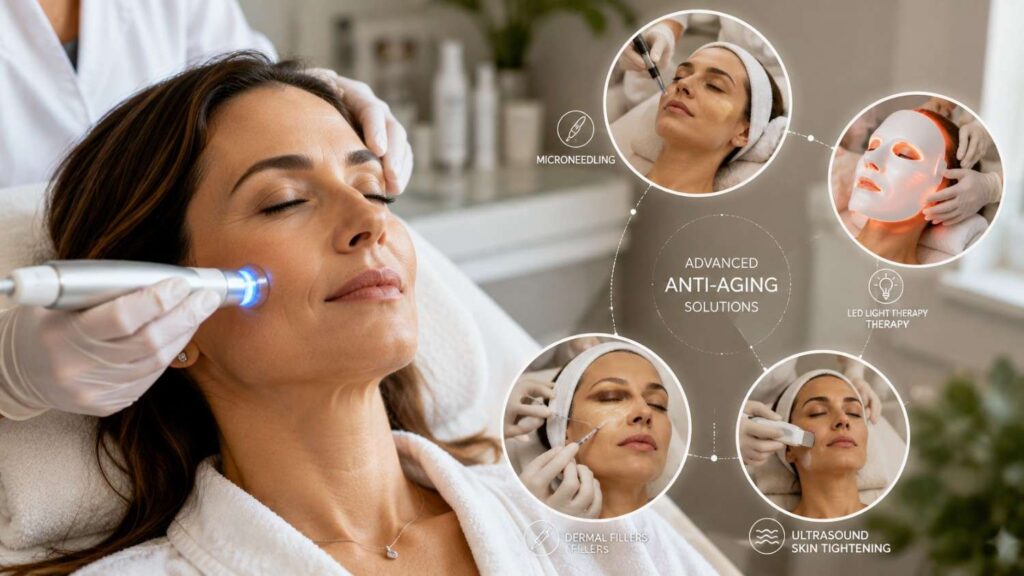
Professional treatments become useful when topical skincare cannot adequately address deeper expression lines, meaningful facial volume loss, pronounced sun damage, scars, textural change, or skin laxity. These treatments work at different anatomical depths, which is why they should not be treated as interchangeable. A neuromodulator changes targeted muscle activity, a filler adds volume, a laser remodels or resurfaces tissue, and microneedling creates controlled injury to stimulate repair. Choosing correctly starts with understanding what each treatment is designed to do.
For additional perspective on how professional options such as Botox, fillers, microneedling, and laser treatments are being used in 2026, this overview of anti-aging treatments provides a useful comparison.
Current AAD guidance includes botulinum toxin, fillers, chemical peels, laser resurfacing, microneedling, ultrasound, and radiofrequency among the professional approaches used for visible signs of aging. The appropriate option depends on facial anatomy, skin tone, medical history, previous procedures, medication use, scar history, desired degree of improvement, and willingness to accept downtime. A treatment that is appropriate for mild texture concerns may be completely inadequate for significant laxity, while an aggressive procedure may be unnecessary for early fine lines.
Safety and practitioner skill are therefore central to the decision. Injectables, lasers, strong peels, and energy-based devices can cause complications when performed incorrectly or used on unsuitable patients. In 2026, consumers should be particularly cautious about procedures marketed as easy or risk-free simply because they are nonsurgical. Nonsurgical does not mean nonmedical. The best in-office anti-aging treatment is one selected after a proper assessment, performed with an appropriate device or product, and delivered by a clinician with relevant training and a clear plan for managing complications if they occur.
| Treatment | Best Suited For | Main Approach | Important Consideration |
|---|---|---|---|
| Botulinum toxin | Dynamic expression lines | Temporarily reduces targeted muscle activity | Requires repeat treatment |
| Dermal fillers | Selected volume loss, folds, contour | Adds volume beneath tissue | Injection technique is critical |
| Laser resurfacing | Wrinkles, texture, sun damage | Controlled light-based resurfacing | Recovery and pigment risk vary |
| Chemical peels | Texture, pigmentation, fine lines | Controlled chemical exfoliation | Strong peels need professional supervision |
| Microneedling | Fine lines, texture, some scars | Controlled micro-injury stimulates collagen | Usually requires a treatment series |
| RF microneedling | Selected texture/laxity concerns | Needles plus radiofrequency heat | FDA has warned of serious reported complications |
Botulinum Toxin and Dermal Fillers
Botulinum toxin injections are among the most established treatments for selected dynamic wrinkles. They work by temporarily reducing activity in targeted muscles, which can soften lines that become more visible with repeated facial expression. Common treatment areas may include certain forehead, glabellar, or eye-area lines depending on the specific approved product and clinical assessment. Results are temporary, so maintenance treatments are generally needed if a person wants to preserve the effect.
Dermal fillers address a different category of aging. Rather than reducing muscle movement, they add volume to selected tissues and may be used to soften particular folds or improve contour in areas such as the cheeks, chin, or lips when clinically appropriate. Different filler materials and product characteristics suit different anatomical locations, which means choosing a filler should involve more than selecting a brand or asking for a specific number of syringes.
Both treatments are medical procedures with meaningful risks. Injection technique, anatomical knowledge, product choice, sterility, and the ability to recognise complications are important. The FDA warns against self-injection and needle-free filler devices, and patients should avoid purchasing injectable products for home use. A natural-looking result usually comes from conservative planning that respects facial proportions rather than simply adding more product.
Laser Resurfacing and Chemical Peels
Laser resurfacing can be particularly valuable when facial aging includes fine or moderate wrinkles, rough texture, uneven pigmentation, and accumulated sun damage. Different laser systems vary in wavelength, depth, energy delivery, and whether they remove surface tissue or work more selectively beneath it. As a result, recovery can range from relatively mild redness to more substantial downtime. The FDA notes that medical lasers are used cosmetically for concerns including wrinkles, scars, and sunspots, but potential adverse effects include pain, infection, scarring, and changes in skin colour.
Chemical peels take a different route by using controlled chemical solutions to exfoliate or remodel selected layers of skin. Superficial peels may be used for relatively mild texture or pigment concerns, while deeper peels can produce more dramatic changes but require greater expertise and recovery. Skin tone, history of pigmentation problems, active skin conditions, medications, and the depth of treatment all influence risk and suitability.
High-strength DIY peels deserve particular caution. The FDA has warned consumers against using potent chemical-peel products without appropriate professional supervision because concentrated acids can cause chemical burns, open wounds, swelling, pain, infection risk, and scarring. For meaningful resurfacing, professional assessment is safer than assuming that a stronger acid automatically produces a better anti-aging result.
| Treatment Category | Primary Target | Treatment Method | Typical Role in an Anti-Aging Plan | Important Safety Consideration |
|---|---|---|---|---|
| Botulinum Toxin | Dynamic wrinkles | Temporarily reduces targeted muscle activity | Expression-line management | Requires qualified medical provider |
| Dermal Fillers | Volume loss and selected folds | Adds volume beneath targeted tissue | Facial contour and volume restoration | Injection technique and anatomy are critical |
| Laser Resurfacing | Wrinkles, texture, sun damage | Controlled light-based skin resurfacing | Skin rejuvenation and resurfacing | Pigment changes, infection, scarring, and downtime vary |
| Chemical Peels | Texture and pigmentation | Controlled chemical exfoliation | Surface-level rejuvenation | Strong formulations require professional supervision |
| Microneedling | Fine lines and texture | Controlled micro-injuries stimulate collagen | Collagen-focused skin rejuvenation | Device, technique, and treatment depth matter |
| RF Microneedling | Selected texture and laxity concerns | Microneedling combined with radiofrequency energy | Advanced device-based rejuvenation | FDA has reported serious complications associated with certain uses |
| Radiofrequency / Ultrasound | Mild to moderate laxity | Energy-based tissue treatment | Selected skin-tightening goals | Device selection and practitioner expertise are important |
Microneedling, RF Microneedling, and Skin Tightening
Traditional microneedling creates controlled microscopic injuries in the skin, triggering a wound-healing response that can support collagen remodelling over time. The FDA has cleared specific microneedling devices for certain indications that include wrinkles, and dermatologists also use professional microneedling for selected texture and scar concerns. Improvement is gradual rather than immediate, and a treatment series may be recommended depending on the problem, device, treatment depth, and individual response.
RF microneedling combines needles with radiofrequency energy, adding controlled heat at selected tissue depths. In October 2025, the FDA issued a safety communication after receiving reports of serious complications with certain uses, including burns, scarring, fat loss, disfigurement, and nerve damage. The agency emphasised that RF microneedling is a medical procedure and should not be performed at home. In 2026, that warning should be part of any informed discussion about benefits, alternatives, practitioner experience, and device selection.
Non-invasive radiofrequency and ultrasound are also used for selected laxity concerns without needles. Results vary, and these treatments are generally better suited to mild or moderate tightening goals than substantial excess skin. When jowling, neck laxity, or tissue descent is advanced, repeatedly adding nonsurgical treatments may provide less value than obtaining a surgical opinion about what can realistically be corrected.
How to Choose the Right Anti-Aging Treatment in 2026
Choosing among The Best Anti-Aging Treatments for 2026 should start with a clear assessment rather than price, popularity, or social-media before-and-after photographs. A person who says they want to “look younger” may actually be concerned mainly about movement-related forehead lines, pigmentation, hollow cheeks, rough texture, or loose neck skin. Those problems respond to different treatments. Defining the main concern first prevents a common mistake: selecting a procedure because it is fashionable and then expecting it to solve an issue it was never designed to treat.
Clinical assessment also matters because not every visible change should be treated cosmetically without evaluation. A brown or changing lesion may need diagnosis before a laser or peel is considered, while a history of abnormal scarring, pigment alteration, active infection, certain medications, or previous cosmetic procedures can affect treatment planning. Skin tone is particularly relevant for resurfacing and energy-based procedures because inflammation can lead to unwanted pigmentation changes in susceptible patients. A qualified clinician should review these factors before recommending treatment intensity.
Provider training affects both the quality of the result and the ability to manage complications. AAD guidance emphasises the value of appropriate medical expertise for cosmetic procedures, while FDA communications repeatedly stress the importance of trained professionals when devices or injectable products are involved. A thoughtful consultation should discuss expected improvement, alternatives, number of sessions, downtime, likely maintenance, potential adverse effects, and what happens if a complication occurs. The right treatment is therefore not simply the one that promises the biggest visible change. It is the option whose likely benefit, risk, recovery, and cost make sense for your individual concern and circumstances.
| Skin Concern | Common Treatment Options | Main Treatment Focus | Key Factors to Consider |
|---|---|---|---|
| Fine Lines & Early Aging | Sunscreen, retinoids, vitamin C, microneedling | Improve texture and reduce visible fine lines | Skin sensitivity, consistency, treatment intensity |
| Dynamic Wrinkles | Botulinum toxin | Temporarily reduce targeted muscle activity | Facial movement, provider expertise, repeat treatments |
| Facial Volume Loss | Dermal fillers | Restore selected facial volume and contour | Facial anatomy, filler type, injection technique |
| Sun Damage & Pigmentation | Sunscreen, retinoids, chemical peels, lasers, IPL | Improve uneven pigmentation and photoaging | Skin tone, pigmentation risk, professional assessment |
| Uneven Skin Texture | Microneedling, chemical peels, laser resurfacing | Resurface skin and support collagen remodeling | Downtime, skin sensitivity, treatment depth |
| Mild Skin Laxity | Radiofrequency, ultrasound, RF microneedling | Support selected skin-tightening goals | Degree of laxity, device selection, provider training |
| Significant Sagging | Surgical consultation, facelift | Address structural tissue laxity and excess skin | Recovery, surgical risks, realistic expectations |
Choose by Concern, Not by Trend
A concern-based framework makes anti-aging decisions much easier. Fine lines and early photoaging may respond to sunscreen, retinoids, vitamin C, and selected resurfacing. Dynamic expression lines are more suited to botulinum toxin, while facial volume loss may call for carefully selected filler or another volume-restoration strategy. Pigmentation and sun damage can require topical therapy, laser or light treatment, or a professional peel after the underlying cause is properly identified.
Texture and shallow wrinkles may respond to microneedling or resurfacing, while meaningful laxity requires a different conversation. Energy-based treatments can help selected mild or moderate cases, but significant loose skin may be better assessed surgically. This distinction prevents people from undergoing repeated low-impact treatments when their actual goal requires structural correction. It also reduces the tendency to overfill a face when the primary problem is tissue descent rather than lack of volume.
The AAD similarly separates treatments for wrinkles, age spots, uneven complexion, and laxity instead of presenting one procedure as suitable for every sign of aging. Use that same logic when evaluating a clinic’s recommendations. Ask what specific problem the treatment is intended to improve, how much improvement is realistic, and which alternatives target the same concern. A trend is only useful when it happens to match your actual needs.
Consider Skin Tone, Downtime, and Risk
Skin tone matters because inflammation from peels, lasers, microneedling, and other procedures can produce post-inflammatory hyperpigmentation or other colour changes in some patients. Device settings, treatment depth, preparation, and aftercare may therefore need to be adjusted rather than copied from a protocol used on someone with different skin characteristics. A history of melasma or previous pigment changes should be discussed before treatment because certain procedures may aggravate pigmentation if poorly selected.
Downtime is another major part of treatment quality, not merely an inconvenience. A subtle procedure with a short recovery may be more appropriate for someone who cannot take time away from work, while another person may accept several days or longer of visible healing in exchange for stronger resurfacing. Ask about redness, swelling, peeling, bruising, sun avoidance, exercise restrictions, makeup use, and when you can realistically return to normal activities.
Risk should be weighed alongside expected benefit. For RF microneedling in particular, the FDA recommends discussing benefits and risks with a licensed provider who has relevant training and asking which specific device will be used. Similar questions apply to injectables and lasers. A reputable clinician should be comfortable explaining complications, not just showing ideal results.
Know When Surgery May Be More Appropriate
Nonsurgical procedures can improve skin quality, wrinkles, mild laxity, and selected areas of volume loss, but they have anatomical limits. A facelift, or rhytidectomy, is designed to address structural aging involving sagging facial tissues, jowls, and loose skin more directly than topical products or minimally invasive treatments. The American Society of Plastic Surgeons describes facelift surgery as a procedure intended to improve visible signs of aging in the face and neck.
This does not mean surgery is automatically the best option for every mature patient. Someone with early fine lines and minimal laxity would not usually need a facelift simply because surgery can produce a larger structural change. The important point is that repeated filler, ultrasound, radiofrequency, or skin-tightening sessions should not be expected to reproduce surgical repositioning when substantial tissue descent or excess skin is the main problem.
A qualified dermatologist or plastic surgeon can help distinguish between skin-quality concerns and structural aging. In some cases, skincare plus injectables is enough. In others, resurfacing or energy-based treatment adds value. For more advanced laxity, obtaining a surgical opinion can clarify what is realistically achievable, even if you ultimately decide against surgery. Good treatment planning starts with understanding the limits of every option.
Quick Answer About The Best Anti-Aging Treatments for 2026
The Best Anti-Aging Treatments for 2026 depend on the specific sign of aging you want to improve rather than on one treatment being universally superior. For prevention and early photoaging, a daily broad-spectrum, water-resistant SPF 30 or higher and an appropriate retinoid remain strong foundations. Retinoids can help mild fine lines, uneven pigmentation, and texture, while moisturiser and carefully selected antioxidants can support the skin barrier and improve overall appearance. These daily measures are especially important because professional procedures cannot prevent new ultraviolet damage from accumulating.
When visible aging is more established, in-office treatments become more relevant. Botulinum toxin is primarily used for selected dynamic expression lines, while dermal fillers can restore volume in appropriately chosen areas. Laser resurfacing and professional chemical peels may improve texture, pigmentation, and signs of sun damage. Traditional microneedling can be useful for fine lines and uneven texture by creating controlled micro-injuries that stimulate wound-healing responses. Energy-based tightening procedures may help selected cases of mild laxity, but they should not be presented as substitutes for surgery when substantial loose skin is present.
The most effective plan therefore begins with a professional assessment of skin quality, facial anatomy, medical history, previous procedures, skin tone, recovery tolerance, and treatment goals. It should also account for safety. In October 2025, the FDA warned about reported serious complications from certain uses of RF microneedling, including burns, scarring, fat loss, disfigurement, and nerve damage. In 2026, a good anti-aging plan is not simply the most aggressive one. It is the safest evidence-informed combination that addresses the right problem with realistic expectations.
Frequently Asked Questions About The Best Anti-Aging Treatments for 2026
People researching The Best Anti-Aging Treatments for 2026 usually want more than a list of procedures. They want to know which options produce meaningful results, how home skincare compares with medical treatment, whether newer devices are safe, and when surgery becomes more appropriate. These questions matter because “anti-aging” covers several different problems, from early sun damage and fine lines to dynamic wrinkles, volume loss, pigmentation, texture changes, and significant skin laxity.
The answers below use a concern-based approach rather than ranking every treatment from best to worst. A sunscreen and retinoid may be highly valuable for prevention and early photoaging but cannot replace lost facial volume. Botulinum toxin can soften selected movement-related lines but does not resurface sun-damaged skin. Microneedling may improve texture gradually, while a facelift addresses deeper structural laxity that skincare and energy-based devices cannot reproduce. Understanding those distinctions makes treatment comparisons far more useful.
Results also vary according to age, skin tone, anatomy, medical history, previous treatment, product or device used, practitioner technique, and willingness to accept downtime. Professional procedures should therefore be discussed with a qualified clinician rather than selected entirely from online before-and-after photographs. The goal of these FAQs is to clarify what each category can realistically do, where safety issues deserve attention, and when a personalised medical assessment becomes more valuable than adding another product or procedure.
What Is the Most Effective Anti-Aging Treatment?
There is no single most effective anti-aging treatment because facial aging does not have one cause. Daily sun protection is fundamental for reducing ongoing photoaging, while retinoids can improve mild fine lines, pigmentation irregularities, and texture over time. These treatments are valuable foundations, but they cannot correct every concern. Their greatest strength is long-term prevention and gradual improvement rather than dramatic structural change.
Professional procedures become more effective when the concern is clearly defined. Botulinum toxin is particularly useful for selected dynamic expression lines, fillers can address specific areas of volume loss, and laser resurfacing or chemical peels may produce greater changes in texture and sun damage. Microneedling can help certain fine lines and texture concerns, while significant laxity may require a surgical assessment rather than repeated topical or device-based treatment.
The most effective plan is therefore the one matched to the problem. For one person, that may mean sunscreen plus a retinoid. For another, it could involve botulinum toxin and resurfacing. Effectiveness should be judged by realistic improvement, safety, durability, and whether the treatment actually targets the underlying concern—not by how aggressive or expensive it is.
Is Botox Better Than Retinol for Wrinkles?
Botulinum toxin and retinol are not direct substitutes because they act in very different ways. Retinol is a topical retinoid that works gradually on the skin and may improve mild fine lines, texture, and pigmentation irregularities. It is most useful as part of a long-term skincare strategy. Results take time, and the main limitation is that a topical retinoid cannot selectively stop the muscle movement responsible for dynamic expression lines.
Botulinum toxin temporarily reduces activity in specific treated muscles. That makes it more effective for selected dynamic wrinkles, such as certain frown lines or crow’s feet, when those lines are strongly driven by repeated expression. It does not replace sunscreen, moisturiser, or retinoids because it does not broadly improve sun damage, pigmentation, or the overall skin surface in the same way skincare and resurfacing treatments can.
Some people may therefore use both approaches when clinically appropriate. Retinoid skincare can support gradual improvements in skin quality while botulinum toxin addresses a defined movement-related concern. The better choice depends on the type of wrinkle, tolerance, medical history, budget, and whether the person prefers ongoing topical care, periodic injections, or a combination recommended by a qualified clinician.
What Is the Best Anti-Aging Treatment for Sagging Skin?
The best treatment for sagging skin depends largely on how much laxity is present and which tissues are contributing to the change. Mild loss of firmness may respond to selected laser resurfacing, ultrasound, radiofrequency, or other collagen-remodelling procedures. In some cases, carefully placed filler can improve support or contour, but filler should not be used simply to “fill away” substantial sagging when the underlying problem is tissue descent.
Moderate or advanced laxity requires more realistic expectations. Energy-based treatments may create some tightening, but they cannot remove significant excess skin or reposition deeper facial structures in the way surgery can. The AAD notes that laser resurfacing can tighten skin and improve wrinkles and dark spots, while the American Society of Plastic Surgeons describes facelift surgery as a structural treatment for sagging facial tissues and loose skin.
For that reason, the best first step is an assessment rather than choosing the strongest advertised device. Ask whether the concern is primarily skin quality, volume loss, or deeper laxity. A qualified dermatologist or plastic surgeon can explain whether nonsurgical tightening is reasonable or whether a surgical consultation would provide a more predictable route toward the desired change.
Does Microneedling Really Work for Aging Skin?
Microneedling can be useful for selected signs of aging, particularly fine lines, uneven texture, and some types of scarring. The treatment uses small needles to create controlled microscopic injuries, which trigger a wound-healing response and collagen remodelling. The FDA has cleared specific microneedling devices for defined indications that include certain wrinkles, and dermatologists commonly use professional microneedling when improving texture is a realistic treatment goal.
Results are gradual because collagen remodelling takes time. A person should not expect the immediate volumising effect of filler or the rapid muscle-relaxing effect of botulinum toxin. More than one treatment session may be recommended depending on the device, treatment depth, concern, and individual response. Temporary redness, swelling, tenderness, or other post-treatment effects can occur, and technique matters for both safety and outcome.
Professional microneedling should also be distinguished from aggressive at-home needling. The AAD has warned about infection and technique risks associated with DIY microneedling. If the goal is meaningful rejuvenation rather than very superficial cosmetic use, professional assessment helps determine whether microneedling, laser resurfacing, a peel, or another procedure is better suited to the problem.
Is RF Microneedling Safe in 2026?
RF microneedling remains a medical aesthetic procedure used by trained professionals, but consumers in 2026 should be aware of an important FDA safety communication issued on October 15, 2025. The FDA reported serious complications associated with certain uses of RF microneedling devices, including burns, scarring, fat loss, disfigurement, and nerve damage. Some reported problems required medical or surgical intervention.
This does not mean every RF microneedling treatment will cause a serious complication, but it changes how the procedure should be discussed. Patients should ask why RF microneedling is being recommended instead of traditional microneedling, laser treatment, ultrasound, or another option. They should also ask which device will be used, what training the practitioner has, how treatment depth and energy are selected, and how complications would be managed.
The FDA states that RF microneedling is a medical procedure and should not be performed at home. Informed consent should include both potential benefits and meaningful risks. If a clinic describes the procedure as completely risk-free or cannot clearly explain the device and practitioner credentials, that is a reason to reconsider the treatment setting.
Are At-Home Red-Light Masks Worth It?
At-home red-light masks may be worthwhile for people who understand that the likely benefit is modest and gradual rather than comparable with injectables or resurfacing procedures. Red and near-infrared light are used in photobiomodulation, and the AAD notes that some studies suggest improvements in concerns such as fine lines, dark spots, roughness, and skin appearance. However, research varies between devices, wavelengths, energy output, and treatment schedules.
That variation matters because two products marketed as “red-light masks” may not deliver identical treatment. A device used in a published clinical study cannot automatically be assumed to represent every consumer mask sold online. Consistency is also important; even a well-designed device is unlikely to produce useful results if it is used only occasionally. Follow manufacturer instructions and pay attention to eye-protection guidance where applicable.
Red-light therapy is best viewed as a complementary option rather than the foundation of an anti-aging routine. Sunscreen, appropriate retinoid use, moisturising, and targeted professional treatment have clearer roles for many concerns. If budget is limited, prioritise those foundations before purchasing a device whose expected improvement may be relatively subtle.
What Anti-Aging Treatments Should Pregnant People Avoid?
Retinoids are one of the clearest anti-aging categories to avoid during pregnancy. Current AAD pregnancy skincare guidance advises avoiding prescription retinoids and over-the-counter retinol products. Anyone who is pregnant, planning pregnancy, or unsure whether a topical or oral medication belongs to the retinoid family should review the product with an obstetric clinician, dermatologist, or other appropriate healthcare professional before use.
Elective cosmetic procedures also deserve a more conservative approach during pregnancy. Injectables, strong peels, lasers, microneedling, and energy-based treatments should not be started simply because they are described as minimally invasive. Safety data may be limited for elective cosmetic use during pregnancy, and changes in skin sensitivity or pigmentation can also affect how a person responds to treatment. A clinician can explain what should be postponed and what basic skincare can continue safely.
Pregnancy is therefore a period when simplifying the routine often makes sense. Focus on gentle cleansing, moisturising, sun protection, and pregnancy-compatible treatments recommended by a qualified professional. Anti-aging goals can usually be revisited after pregnancy when treatment choices can be assessed with a broader safety margin and clearer evidence.
Conclusion
The Best Anti-Aging Treatments for 2026 are not necessarily the newest products, devices, or procedures. The strongest strategy combines proven prevention with targeted correction. Daily sun protection remains essential for limiting further photoaging, while retinoids continue to have an important role for selected fine lines, uneven pigmentation, and texture. Moisturiser and complementary ingredients can support skin quality, but professional treatment becomes more relevant when the main concern involves dynamic wrinkles, deeper texture change, facial volume loss, scars, or meaningful laxity that skincare cannot realistically correct.
The key is to identify what is actually creating the aged appearance before choosing a treatment. Muscular movement, accumulated sun damage, pigmentation, surface texture, collagen changes, loss of facial volume, and tissue descent are related but distinct problems. Botulinum toxin, fillers, peels, lasers, microneedling, radiofrequency, ultrasound, and surgery each have different roles. A treatment can be highly effective for the right indication and disappointing for the wrong one. That is why personalised assessment matters more than simply selecting the procedure with the strongest marketing claims.
Safety should remain part of the definition of a good result. The FDA’s 2025 RF microneedling safety communication is a useful reminder that “nonsurgical” does not mean risk-free. Similar caution applies to injectables, medical lasers, strong chemical peels, and aggressive at-home treatments. In 2026, a professional anti-aging plan should balance likely improvement with downtime, cost, maintenance, skin tone, anatomy, medical history, and complication risk. The objective is not to use every available treatment. It is to build a proportionate plan that improves the concerns that matter most while protecting long-term skin health.
Start With the Foundation
For most people, I recommend beginning with a simple foundation: broad-spectrum sun protection, gentle cleansing, appropriate moisturising, and an evidence-supported active ingredient that suits the skin. A retinoid may be useful for many people concerned about mild photoaging, while vitamin C or other complementary ingredients can be added for specific goals. The routine should remain comfortable enough to follow consistently rather than causing constant irritation in pursuit of faster results.
Once that foundation is stable, evaluate what remains. If expression lines continue to bother you, botulinum toxin may be worth discussing. If volume loss is the main issue, filler or another volume strategy may be more logical. Texture, scars, or pigmentation may point toward resurfacing, peels, or microneedling. Significant laxity may require a different level of assessment. This stepwise approach makes every addition purposeful.
Starting simply also makes it easier to judge results and side effects. When several new products and procedures are introduced at once, it becomes difficult to know what helped or caused irritation. A measured plan is easier to maintain, easier to adjust, and more likely to support long-term skin health than repeatedly changing routines according to trends.
Prioritise Qualified Medical Care
Injectables, professional microneedling, RF microneedling, strong chemical peels, medical lasers, and surgery all require appropriate expertise. Provider knowledge affects treatment selection, technique, complication prevention, and the ability to respond when something does not go as expected. AAD guidance stresses the importance of qualified medical care for cosmetic procedures, while FDA communications reinforce professional supervision for fillers, medical devices, and strong chemical peels.
Before treatment, ask who will perform the procedure, what qualifications and specific training they have, which product or device will be used, and whether it is appropriate for your skin tone and concern. A good consultation should also cover alternatives, expected improvement, maintenance, downtime, side effects, and warning signs that require medical attention. A practitioner who discusses limitations clearly is often more trustworthy than one who guarantees a perfect result.
Choose a treatment plan based on your anatomy, health, priorities, and realistic goals rather than a trend-driven checklist. Good anti-aging care is not measured by how many procedures you can combine. It is measured by whether each intervention has a clear purpose, an acceptable safety profile, and a result that fits naturally with the rest of your face and skin.