
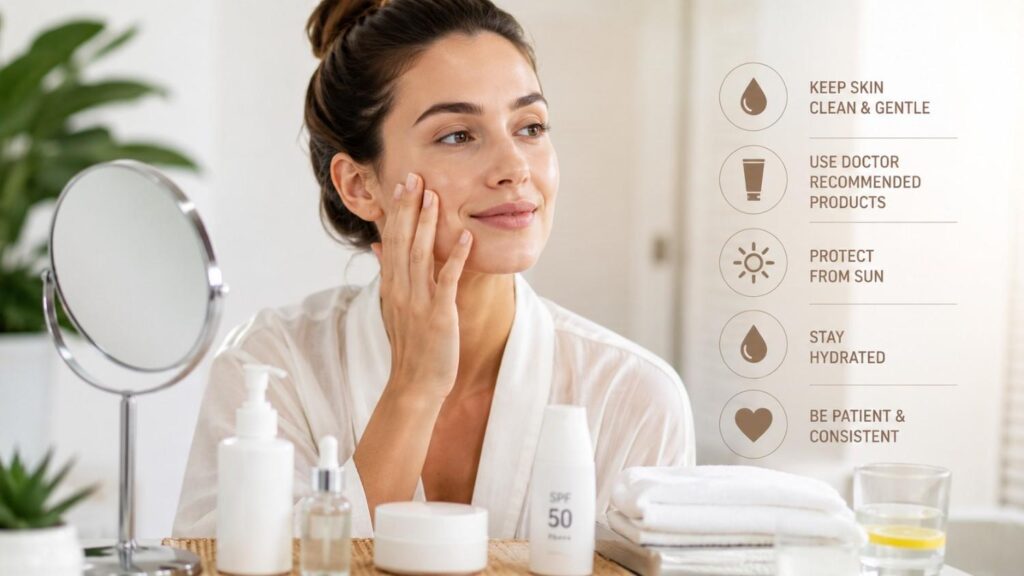
What matters most immediately after treatment?
Immediately after treatment, your first responsibility is to protect the area from unnecessary irritation while following the recovery plan provided by your clinician. That may mean leaving the skin largely untouched, performing prescribed cleansing or soaking, applying an ointment, using a recommended moisturizer, avoiding makeup, or limiting strenuous activity. The correct combination depends on the procedure.
Resurfacing treatments deserve particular caution because the skin may temporarily function more like a healing wound than ordinary untreated skin. AAD guidance for medium and deep chemical peels includes specific soaking, ointment, moisturizing, antiviral, and sun-avoidance instructions depending on peel depth.
Microneedling has different concerns. FDA guidance explains that treated skin may temporarily be sensitive to sunscreen, cosmetics, moisturizers, and ingredients such as retinol, glycolic acid, menthol, capsaicin, or alcohol.
Injectables require another approach. After fillers, AAD advises avoiding strenuous activity until the next day and generally avoiding touching the area unless specific massage instructions are given. Botulinum toxin guidance focuses on avoiding rubbing or massage and temporarily delaying strenuous activity.
Which advice should take priority?
The instructions from the qualified professional who performed your procedure should take priority over generic online timelines. This is not simply a conservative disclaimer. Treatment depth, device settings, the substance injected, the area treated, your skin characteristics, medications, health history, and whether complications occurred can all change what appropriate recovery looks like.
Chemical peels demonstrate this clearly. AAD guidance distinguishes between superficial, medium, and deep peels, with healing ranging from roughly several days to several weeks and with different rules for wound care, makeup, follow-up, and sun avoidance.
Microneedling also varies according to the device and how deeply it penetrates. FDA-authorized medical microneedling devices can reach living skin layers, nerves, and blood vessels, while less invasive cosmetic rollers may work only at the surface.
This is why another person’s social-media recovery diary should never replace your own aftercare plan. Even if the procedure has the same name, it may not have been performed at the same intensity or with the same technology.
If written instructions and general internet advice conflict, contact the treating clinic for clarification rather than trying to decide which rule to follow yourself.
Full Article
The full guide below is designed to help readers understand the logic behind post-procedure care rather than memorize a universal recovery calendar. Cosmetic procedures affect tissues in different ways. Some intentionally remove or damage surface layers so new skin can heal, some create microscopic channels, and others place an injectable product beneath the skin without creating a large surface wound.
Those differences affect everything from cleansing to exercise. A person recovering from a medium chemical peel may need wound-care steps, strict sun avoidance, and a delayed return to makeup. Someone receiving botulinum toxin can often resume normal daily activities immediately but should avoid rubbing the injected areas and briefly delay strenuous activity.
Aftercare should therefore have two levels. The first level is procedure-specific medical guidance from the treating provider. The second is a set of broader principles: reduce irritation, avoid manipulating healing skin, protect against UV exposure as directed, restart products cautiously, and monitor for symptoms outside the expected recovery pattern.
Maintenance also continues after visible healing ends. Cosmetic treatments do not stop biological aging, sun exposure, acne, pigment formation, or other processes affecting skin. Some injectable and device-based results are temporary by design. FDA guidance for microneedling notes that improvement may be temporary and maintenance procedures may be needed, while AAD describes botulinum toxin effects as generally lasting several months.
How to Maintain Your Skin After a Cosmetic Treatment: A Practical Aftercare Guide
Learning how to maintain your skin after a cosmetic treatment begins before you reach for a cleanser, serum, or sunscreen. The first question is: what procedure did you have, and what did your clinician tell you to do afterward?
That matters because cosmetic procedures are not one category of identical skin treatments. Chemical peels intentionally produce controlled exfoliation at varying depths. Laser resurfacing can produce redness, swelling, peeling, crusting, or more substantial wound-like recovery depending on the treatment. Microneedling creates controlled punctures and may temporarily increase sensitivity to cosmetics and active ingredients. Fillers and botulinum toxin are injectable treatments with their own post-injection precautions.
The goal of aftercare is not to make healing happen as quickly as possible at any cost. It is to give the treated area an appropriate environment to recover while reducing avoidable triggers for irritation, infection, scarring, pigmentation changes, or disruption of the intended result.
For beginners, the safest approach is conservative. Follow written instructions, keep approved products simple, do not pick or scratch healing skin, and ask before restarting strong actives.Advanced skin-care users often need to be especially disciplined because they may own retinoids, exfoliating acids, benzoyl peroxide, vitamin C products, scrubs, devices, and other treatments that are useful on normal skin but may be inappropriate during early recovery.Good aftercare is not passive. It is structured, procedure-specific skin management.
Protect Your Skin During the Early Recovery Period
The early recovery period deserves the most caution because treated tissue may be inflamed, fragile, swollen, dry, peeling, or temporarily more permeable than usual. Depending on the procedure, the skin may simply look mildly pink or may behave more like a healing wound. AAD chemical-peel guidance, for example, ranges from simple lotion or cream after a superficial peel to multiple daily soaks, ointment, antiviral medication, dressings, and follow-up after deeper peels.
Laser resurfacing can also cause very different levels of recovery. ASPS notes that treated skin may feel like a mild sunburn with redness and swelling, while more intensive treatments can produce raw, oozing, blistered, or crusted skin. Picking crusts is specifically discouraged because it may contribute to scarring.
For additional guidance on protecting healing skin, this overview of cosmetic surgery aftercare emphasizes gentle skin care, sun protection, and allowing treated areas to heal without unnecessary interference.
Microneedling can cause dryness, roughness, redness, tightness, itching, peeling, discomfort, bruising, bleeding, burning, or crusting. Most short-term effects resolve, but infection and pigmentation changes are among recognized less common risks.
The practical lesson is to treat your early recovery instructions as part of the procedure itself. Do not improvise because the skin “looks fine” the next morning.
Keep hands clean before touching the treatment area, use only provider-approved products, and avoid unnecessary manipulation. If the clinic supplied written instructions, save them somewhere easily accessible and follow them until you are explicitly told that normal skin care can resume.
Follow Your Provider’s Aftercare Instructions Exactly
A detailed aftercare plan should tell you what to do, what not to do, and when normal activities can resume. Ideally, you should know how to cleanse the treated area, whether you need ointment or moisturizer, when you can apply sunscreen or makeup, whether exercise should be delayed, and which symptoms require a phone call.
This is particularly important for treatments with variable intensity. After a superficial chemical peel, AAD notes that lotion or cream may be used until healing is complete and makeup may sometimes be worn immediately or the next day. A medium peel can involve 7–14 days of healing with soaks, ointment, antiviral medication, delayed makeup, and complete sun avoidance until the skin heals. Deep peels have still more intensive wound care and follow-up.
Do not replace these instructions with a generic “post-procedure kit” unless your provider approves it. A product marketed as soothing may still contain fragrance, exfoliating ingredients, acids, alcohol, or botanicals that are not appropriate for freshly treated skin.
One practical step I recommend is taking a photo of your written instructions and storing the clinic’s phone number with it. If questions arise at night or the next morning, you will not need to reconstruct the plan from memory.
Avoid Picking, Scratching, Rubbing, or Over-Treating
Peeling, flaking, crusting, swelling, or temporary roughness can make people want to “help” the skin recover. In many cases, that instinct creates unnecessary risk. AAD guidance for chemical peels specifically warns that rubbing or scratching treated skin can contribute to infection, while ASPS advises against picking crusts after laser resurfacing because of scarring risk.
Rubbing also matters after injectables, but for a different reason. Following botulinum toxin treatment, AAD and ASPS advise against rubbing or massaging the injection sites because unwanted movement of the toxin could affect nearby muscles.
Fillers demonstrate why exceptions matter. AAD generally advises avoiding touching the treated area for several days unless the dermatologist gives massage instructions. Poly-L-lactic acid is one example where clinician-directed massage may be required.
The rule is therefore not “never touch the skin.” The rule is do not manipulate the treated area unless your procedure-specific instructions tell you to do so.
Avoid exfoliating flakes, squeezing bumps, peeling crusts, using cleansing brushes, applying facial tools, or performing aggressive massage simply because the skin feels uneven. Healing tissue often looks less polished before it looks better.
Rebuild Your Post-Treatment Skin Care Routine Gradually
Returning to skin care should be treated as a progression, not an on/off switch. After some procedures, your skin may temporarily be more reactive to ingredients that you previously used without problems. FDA microneedling guidance specifically warns that treated skin may be more sensitive to products including sunscreen, makeup, moisturizers, retinol, glycolic acid, menthol, capsaicin, and alcohol.
This is one reason a “back to normal in 48 hours” rule is unreliable. Procedure intensity, treated area, skin condition, and the product being reintroduced all matter.
A sensible rebuilding process usually begins with whatever cleansing, moisturizing, wound-care, and sun-protection steps the clinician recommends. Once the skin has reached the stage your provider considers healed enough, additional products can return gradually.
For advanced skin-care users, restraint is important. Using a retinoid, exfoliating acid, benzoyl peroxide, strong vitamin C formula, facial scrub, cleansing device, and treatment mask on the first night you are “allowed” to resume skin care creates multiple variables at once. If irritation develops, you may not know which product caused it.
A gradual approach makes reactions easier to identify and reduces the temptation to treat temporary redness or texture with additional aggressive products.
Remember that visible recovery and complete biological recovery are not always the same thing. A treated area may look relatively normal before it is ready for every active ingredient you used beforehand. Use your provider’s guidance, not appearance alone, to decide when to advance the routine.
Post-Treatment Skin Care Routine
| Skin-Care Step | Recovery Focus | What to Keep in Mind |
|---|---|---|
| Cleansing | Keep treated skin clean without unnecessary friction | Use the cleansing method and timing recommended by your provider |
| Moisturizing | Support comfort and the skin barrier | Choose a simple moisturizer when your clinician approves it |
| Active Ingredients | Reduce irritation during healing | Delay retinoids, exfoliating acids, and other irritating products until cleared |
| Makeup | Avoid unnecessary contact with sensitive skin | Follow procedure-specific guidance before applying makeup |
| Sun Protection | Reduce UV exposure during recovery | Start sunscreen when approved and combine it with shade and protective clothing |
| Product Changes | Keep the routine simple | Avoid introducing unfamiliar or unapproved products during healing |
Use Gentle Cleansing and Moisturizing When Approved
Once cleansing is permitted, the goal is usually to clean the area without creating unnecessary friction. The exact cleanser, water temperature, frequency, and technique should follow the procedure-specific plan. In some recovery protocols, especially after deeper resurfacing, cleansing may involve saline, diluted solutions, prescribed soaking, or other wound-care methods rather than an ordinary facial cleanser. ASPS, for example, describes cleansing laser-treated areas with saline or diluted vinegar solution as directed by the surgeon.
Moisturizing can also play an important role. AAD chemical-peel guidance advises using moisturizer as directed and warns that overly dry, cracked healing skin can scar.The important phrase is as directed. A moisturizer that is excellent for your everyday skin may contain ingredients your provider does not want on freshly treated tissue.Avoid introducing new fragranced products, strong botanical blends, essential oils, exfoliating cleansers, or products marketed as “detoxifying” simply because they seem gentle or natural.
General post-procedure skin care guidance also supports gentle cleansing, moisturizing, sun protection, and avoiding harsh products while the skin recovers.
Pat the skin rather than scrubbing if that matches your instructions, and use clean hands. If a provider-prescribed ointment or dressing is part of the recovery plan, do not substitute your usual moisturizer without asking.During early healing, simplicity is often a strength rather than a sign that your routine is incomplete.
Restart Retinoids, Acids, and Makeup Only When Cleared
Retinoids and exfoliating acids can be valuable in ordinary skin-care routines, but immediately after certain cosmetic procedures they may be too irritating. FDA microneedling guidance specifically notes that products containing retinol or glycolic acid may sting or irritate temporarily sensitized skin.
The correct restart point varies substantially. After chemical peels, makeup timing alone can range from immediate or next-day application after some superficial peels to at least 14 days after a deep peel.
That variability is a useful reminder that there is no reliable universal schedule for retinoids, exfoliating acids, benzoyl peroxide, strong vitamin C formulations, or other actives.
When your clinician clears you to restart products, consider reintroducing them gradually rather than returning to an advanced multi-active routine in one evening. This is a practical strategy for identifying irritation, not a medical requirement for every procedure.
Makeup deserves similar caution. The fact that redness is visible does not automatically mean it is safe to cover. A healing surface may need more time before foundation, brushes, sponges, or removers are appropriate.If the clinic did not tell you when to restart a specific product, ask directly. “Can I return to my skin care?” is less useful than naming the product and concentration you plan to use.
Related Articles
Protect Treated Skin From the Sun and Maintain Your Results
Ultraviolet protection is particularly important after many procedures because resurfaced or inflamed skin can be vulnerable to sun-related complications and pigment changes. AAD chemical-peel guidance requires complete sun avoidance during the healing period for medium peels and much longer avoidance after deep peels, while daily sunscreen is recommended after healing to help maintain results.
Sun protection after treatment should be thought of as a layered strategy rather than simply “wear SPF.” During periods when your provider does not yet want sunscreen placed on healing skin, shade, hats, clothing, and avoiding unnecessary exposure may become even more important. Once sunscreen is permitted, use the formulation and timing recommended by the treating clinician.
Pigmentation risk deserves additional consideration. FDA lists hyperpigmentation and hypopigmentation among less common microneedling risks.
Long-term sun exposure can also continue the same photoaging processes that cosmetic procedures are often intended to improve. Protecting the skin therefore matters not only for short-term healing but also for preserving the cosmetic benefit.
A good maintenance plan should ask two separate questions: “How do I protect healing skin this week?” and “How do I reduce preventable UV damage over the coming months and years?”
The answers may involve different products and restrictions, but the principle is consistent: avoid unnecessary ultraviolet exposure and follow professional guidance on when sunscreen can safely be applied.
Make UV Protection Part of Your Recovery Plan
Sun protection should be planned before you leave the clinic, especially after peels, laser procedures, or microneedling. Ask when sunscreen can be applied, what SPF and formulation your clinician recommends, whether a hat is sufficient for brief outdoor movement, and how long intentional sun exposure should be avoided.
Do not assume that your normal sunscreen will automatically feel comfortable. FDA notes that sunscreen itself can sting or itch when applied to skin after microneedling because product sensitivity may be temporarily increased.
That does not mean sunscreen is unimportant. It means product timing and formulation need to fit the stage of healing.
Chemical-peel protocols can be particularly strict. AAD describes total sun avoidance until healing after medium peels and prolonged avoidance after deep peels, followed by regular sunscreen use once the skin has healed.
Plan practical details such as transportation, work near windows, outdoor exercise, errands, hats, umbrellas, and shade rather than thinking only about beach days.
After recovery, regular UV protection can help prevent additional photoaging and pigment change that might undermine the cosmetic improvement you sought from treatment.
Think Beyond Recovery and Protect the Investment
Successful aftercare does not end the moment redness disappears. Once the clinician considers the skin adequately recovered, maintenance shifts from wound protection to sustainable everyday skin care.
For many people, that means returning to a manageable routine with appropriate cleansing, moisturizing, sun protection, and selected active ingredients based on skin needs. Avoid assuming that more products will make treatment results last proportionally longer.
Some cosmetic results are temporary because of how the treatment works. AAD notes that botulinum toxin used for facial lines generally lasts about three to four months and sometimes longer. Temporary fillers can usually be repeated when signs of aging reappear.
FDA guidance similarly notes that microneedling improvement may be temporary and some patients may need more than one procedure or future maintenance.
Skin care cannot make a temporary injectable permanent, but it can help you avoid unnecessary irritation and sun damage around the result.
Maintain realistic expectations, attend recommended reviews, and discuss future treatments based on the expected life of the procedure rather than scheduling them simply because social media suggests a fixed interval.
How Aftercare Changes by Cosmetic Treatment Type
Cosmetic aftercare becomes easier to understand when treatments are grouped according to what they do to the tissue. Resurfacing procedures such as chemical peels and laser resurfacing intentionally alter the skin surface and can require wound-oriented recovery. Microneedling procedures create controlled punctures and can temporarily increase product sensitivity. Injectables place substances under the skin or into muscle and generally have less surface recovery but include restrictions designed to reduce swelling, bruising, pressure, or unwanted product movement.
Cosmetic Treatment Aftercare Priorities
| Cosmetic Treatment | Main Recovery Priority | Key Aftercare Consideration |
|---|---|---|
| Chemical Peel | Moisture and skin protection | Recovery depends heavily on peel depth and may include peeling, crusting, or extended sun precautions |
| Laser Resurfacing | Barrier protection and UV avoidance | Protective skin care, moisturizer, and delayed use of active ingredients may be required |
| Microneedling | Gentle skin care and product caution | Treated skin may become temporarily sensitive to products such as retinol and exfoliating acids |
| Dermal Fillers | Minimize unnecessary pressure | Swelling and bruising can occur, while massage and activity instructions depend on the specific treatment |
| Botulinum Toxin | Avoid rubbing or massaging injection areas | Follow the injector’s instructions for physical activity and post-treatment care |
Even within these groups, aftercare differs. A superficial chemical peel is not comparable with a deep peel. Standard microneedling is not necessarily equivalent to radiofrequency microneedling; in October 2025, FDA issued a safety communication regarding serious reported complications with certain uses of RF microneedling, including burns, scarring, fat loss, disfigurement, and nerve damage.
Injectables also vary. AAD states that most filler patients can resume everyday activities after leaving the office, but strenuous activity should generally wait until the following day, and treatment-specific massage instructions may apply. Botulinum toxin usually involves little conventional downtime but has precautions against rubbing or massaging the injected areas.
Use the table below as an orientation tool, not as a substitute for your own discharge instructions.
| Treatment Type | Common Aftercare Focus | Important Caution |
|---|---|---|
| Chemical peel | Moisture, wound care, sun protection/avoidance | Recovery varies greatly by peel depth |
| Laser resurfacing | Cleansing, protective skin care, moisturizer, sun protection | Do not pick crusting or peeling skin |
| Microneedling | Gentle care, product caution, sun awareness | Products may temporarily sting or irritate |
| Dermal fillers | Minimize unnecessary pressure and follow activity guidance | Massage rules depend on filler |
| Botulinum toxin | Avoid rubbing injected areas | Follow injector’s activity instructions |
Resurfacing Treatments Need Extra Barrier and Sun Care
Resurfacing procedures often require more involved skin care because the treatment intentionally alters the outer skin layers. Chemical peels are a clear example. AAD describes healing times of approximately 1–7 days for superficial peels, 7–14 days for medium peels, and 14–21 days for deep peels, with progressively more intensive wound care.
Medium and deep peels may involve swelling, blistering, crusting, soaking, ointments, antivirals, delayed makeup, and follow-up. Deep peels may require dressings and prolonged sun avoidance.
Laser resurfacing can similarly produce redness, swelling, itching, stinging, peeling, crusting, or more severe wound-like reactions depending on treatment intensity. ASPS specifically advises against picking crusts because this can contribute to scarring.
Microneedling usually has less visible downtime, but FDA lists redness, tightness, dryness, itching, peeling, discomfort, bruising, bleeding, and crusting among possible effects. Product sensitivity is also recognized.
For all of these treatments, the key is to respect the barrier-recovery period instead of trying to exfoliate, polish, or accelerate visible peeling.
Injectables Have Different Pressure and Activity Rules
Injectables usually do not create the same broad surface wound as a peel or laser, so aftercare focuses more on swelling, bruising, pressure, activity, and the behavior of the injected product.
After fillers, AAD states that most patients can return to everyday activities after leaving the office. Temporary redness, swelling, tenderness, or bruising may occur. AAD recommends waiting until the next day before strenuous exercise, avoiding sun and tanning, and generally avoiding touching the treatment area for several days unless the dermatologist gives specific massage instructions.
That massage exception is important. Poly-L-lactic acid filler can require a specific massage routine, demonstrating why generic “never massage filler” advice can also be wrong.
Botulinum toxin has different guidance. AAD says most people can return to normal activities immediately and can apply makeup, but the injected area should not be rubbed or massaged, and strenuous activity should be delayed for two hours.
The safest approach after any injectable is to follow the specific injector’s instructions for the exact product and anatomical area treated.
Know the Difference Between Normal Recovery and a Warning Sign
Every cosmetic procedure has an expected recovery pattern, and understanding that pattern is one of the most useful things you can do before treatment. “Normal” is not a fixed list that applies to everyone. Redness and peeling may be expected after a resurfacing treatment, bruising may occur after an injectable, and tightness or itching can appear after microneedling.
The more useful comparison is not between your skin and somebody else’s photos. Compare your symptoms with what your clinician told you to expect for your procedure.
Before leaving the office, know the expected severity, when symptoms should peak, when they should begin improving, and what would be considered unusual. Keep the clinic’s contact information readily available.
A concerning pattern can include symptoms that become progressively worse instead of better, symptoms that are much more severe than expected, or entirely new symptoms outside the normal recovery plan. Depending on the treatment, infection, pigment alteration, burns, scarring, delayed healing, or other complications may occur. FDA lists infection and pigmentation changes among recognized microneedling risks, while its RF microneedling safety communication describes reports of serious burns, scarring, fat loss, disfigurement, and nerve damage.
Do not attempt to “treat through” an unexpected complication with acids, retinoids, scrubs, home remedies, or additional cosmetic devices.
Contact Your Provider When Recovery Is Not Following the Expected Pattern
Contact your treating provider when your symptoms are substantially different from the recovery course you were given. The exact threshold depends on the procedure, but worsening pain, unexpected blistering, spreading redness, concerning drainage, pronounced discoloration, delayed healing, or severe swelling should not simply be ignored because the procedure was cosmetic.
AAD tells chemical-peel patients to contact their dermatologist if treated skin burns, itches, or swells and warns that improper wound care, scratching, premature makeup, inadequate sun protection, or tanning can increase the risk of complications such as infection or scarring.
FDA guidance for microneedling lists less common complications including pigment changes, reactivation of cold sores, swollen lymph nodes, and infection. It advises patients to discuss care and complications with an appropriately trained provider.
If you are uncertain whether a symptom is normal, contacting the clinic is appropriate. You do not need to wait until a problem becomes dramatic before asking.
Take clear photographs if the clinic requests them, describe when symptoms began, and tell the provider exactly which products or medications you have used since treatment.
Some Injectable Complications Require Urgent Medical Care
Most temporary injectable side effects are relatively minor, but serious complications can occur and should not be treated as routine aftercare issues. The appropriate response to severe or rapidly developing symptoms is medical evaluation, not additional skin care.
AAD lists rare botulinum-toxin-related symptoms resembling botulism, including problems breathing, swallowing, or speaking.
Dermal fillers can also cause serious complications if material enters or compresses a blood vessel. While ordinary bruising, redness, swelling, or tenderness may be temporary, severe pain, marked skin color changes, visual symptoms, or neurological symptoms require urgent professional assessment rather than home treatment.
The broader safety principle extends to device procedures. FDA’s 2025 RF microneedling communication reports serious adverse events including burns, scarring, fat loss, disfigurement, and nerve damage and advises people with concerns after such a procedure to seek care from a licensed health-care provider.
If you develop difficulty breathing or swallowing, sudden visual changes, neurological symptoms, rapidly worsening severe pain, or another potentially serious reaction, seek urgent medical care rather than waiting for a routine follow-up appointment.
Quick Answer Section
This section gives readers the core answer before the article moves into treatment-specific detail. Good aftercare is less about adding extra products and more about protecting the recovery process from unnecessary friction, irritation, ultraviolet exposure, and poorly timed active ingredients.
A cosmetic treatment can temporarily change the way skin behaves. Resurfacing procedures may disrupt or intentionally injure the outer skin layers, while microneedling creates controlled punctures and can make skin temporarily more sensitive to products. Injectables do not involve the same type of skin-barrier recovery, but they can have their own restrictions involving rubbing, pressure, exercise, or massage.
Because of these differences, the safest universal rule is not “wait three days” or “use only moisturizer for one week.” The safest rule is to obtain a written recovery plan from the professional who performed the treatment and follow it until you are specifically cleared to change your routine.
Readers should also know what symptoms are expected. Redness, swelling, bruising, peeling, tenderness, or temporary sensitivity may be routine after one procedure but concerning after another. FDA guidance for microneedling, for example, lists redness, tightness, itching, peeling, discomfort, bruising, bleeding, and crusting among recognized effects, with less common risks including pigment changes and infection.
Quick Answer About How to Maintain Your Skin After a Cosmetic Treatment
The best way to maintain your skin after a cosmetic treatment is to protect the treated area, minimize irritation, and follow the exact aftercare instructions provided by your clinician. Do not immediately return to every cleanser, serum, retinoid, exfoliating acid, makeup product, or exercise habit you used before treatment unless your provider has confirmed that it is appropriate.
Recovery requirements vary widely. A superficial chemical peel may involve several days of redness or scaling, while a deep peel can require weeks of wound care and extended sun avoidance. Microneedling can make skin temporarily more sensitive to sun and skin-care products, while fillers and botulinum toxin generally involve different restrictions related to pressure, massage, or strenuous activity.
Keep the routine simple during early recovery. Use only approved cleansing, moisturizing, wound-care, and sun-protection products. Avoid picking, scratching, or experimenting with new active ingredients while the skin is healing.
If redness, pain, swelling, discoloration, blistering, visual symptoms, weakness, difficulty breathing, or other symptoms become severe or differ from what your clinician told you to expect, seek professional advice promptly.
FAQ Section
The FAQ section addresses common post-treatment questions that often receive overly simple answers online. The central challenge is that users frequently ask, “When can I wash my face?” or “When can I use retinol again?” without specifying the procedure.
That missing detail matters. A person recovering from superficial microneedling does not necessarily follow the same schedule as someone recovering from deep laser resurfacing. A patient with a superficial chemical peel may be permitted to use makeup rapidly, while AAD says a deep peel can require at least 14 days before makeup is applied.
Similarly, activity guidance differs between injectables. AAD advises filler patients to wait until the next day before strenuous activity, whereas its botulinum toxin guidance recommends waiting two hours before strenuous exercise.
The correct answer to many aftercare questions is therefore not a universal number of hours. It is a decision based on the exact procedure, its intensity, the treated location, how your skin is recovering, and the instructions from the professional who performed it.
Readers should use these FAQs to understand the issues they need to discuss with their provider. Where specific official timelines exist, they are included as examples rather than rules for every cosmetic procedure.
Frequently Asked Questions About How to Maintain Your Skin After a Cosmetic Treatment
The most common questions about how to maintain your skin after a cosmetic treatment usually involve cleansing, moisturizer, sunscreen, makeup, exercise, active ingredients, and whether a symptom is normal. These are sensible questions because daily habits that were harmless before a procedure may need temporary modification during recovery.
The safest way to answer them is to begin with the treatment category. If your procedure disrupted the skin barrier—such as a peel, laser treatment, or microneedling—product timing and wound care may dominate the recovery plan. If you had fillers or botulinum toxin, pressure, massage, swelling, and activity restrictions may be more relevant.
Do not judge recovery exclusively by how the skin looks in the mirror. Some products can sting after microneedling even when the skin appears relatively calm. Conversely, visible redness after a peel may be part of the expected healing process.
Ask your provider precise questions: “When can I use my 0.05% tretinoin again?” is better than “When can I use skin care?” Likewise, ask when you may return to running, swimming, sauna use, makeup, shaving, or any activity that matters to your routine.
The following answers explain why these decisions vary and what current authoritative guidance says.
Can I wash my face after a cosmetic treatment?
In many cases, yes—but when and how you wash your face depends on the treatment. You should not assume that your normal cleanser, washcloth, facial brush, water temperature, and cleansing pressure are appropriate immediately afterward.
After deeper resurfacing procedures, cleansing may become part of formal wound care. ASPS describes laser-resurfacing recovery protocols that can include cleaning the treated areas several times per day with saline or a diluted vinegar solution according to the surgeon’s instructions.
Chemical peels also have procedure-depth-specific home care, including prescribed soaking and ointments after medium and deep peels.
After less disruptive treatments, normal gentle cleansing may return sooner, but the provider should still determine the timing.
When washing is allowed, avoid aggressive scrubbing unless you were specifically instructed otherwise. Use clean hands and the approved cleanser or wound-care solution.
If water, cleanser, or moisturizer causes unexpectedly intense burning or pain, stop and contact the clinic for guidance instead of repeatedly washing in an attempt to “clean” the sensation away.
When can I restart retinol or exfoliating acids?
There is no universal number of days for restarting retinol, tretinoin, glycolic acid, salicylic acid, exfoliating toners, or similar active products after cosmetic treatment.
FDA microneedling guidance specifically says skin may become more sensitive to products containing retinol and glycolic acid after treatment.
The correct timing depends on how strongly the procedure altered the skin and whether the surface has recovered. A superficial treatment may allow an earlier return than deep resurfacing, but appearance alone should not determine the decision.
Ask your clinician about the specific product and strength you use. Prescription tretinoin, low-strength retinol, exfoliating pads, and high-concentration home acids do not necessarily belong under one restart rule.
Once you are cleared, a gradual return can make irritation easier to identify. Avoid restarting every strong product on the same night unless your clinician specifically tells you to do so.
If you notice persistent burning, significant redness, swelling, or an unusual reaction when an active is reintroduced, stop using it and ask the treating provider whether the skin needs more recovery time.
When can I wear makeup again?
Makeup timing depends heavily on the procedure and depth of treatment. It should not be based solely on whether you feel comfortable being seen with redness.
AAD chemical-peel guidance shows how widely timing can vary. After some superficial peels, makeup may be allowed immediately or the next day. After medium peels, camouflage makeup may be possible after approximately five to seven days, while deep peels require at least 14 days before makeup.
AAD microneedling guidance says patients should wait 24 hours before applying makeup.
These are procedure-specific examples, not universal rules for all treatments.
Makeup can introduce friction through brushes, sponges, blending, and removal. Products may also sting when the barrier is still sensitive.
When makeup is cleared, keep applicators clean and avoid excessive rubbing. Do not use makeup to conceal a potentially concerning complication instead of having it assessed.
If your recovery instructions do not specify makeup timing, contact the clinic before applying foundation, concealer, powder, or other products over treated skin.
Should I use sunscreen after cosmetic treatment?
Sun protection is important after many cosmetic procedures, but immediately treated skin may temporarily require a different approach to sunscreen application.
FDA notes that skin after microneedling may be more sensitive to sunscreen and other cosmetics.
After chemical peels, AAD guidance can require complete sun avoidance during healing, particularly after medium and deep peels, followed by daily sunscreen after the skin has healed.
This is why you should ask not just “Should I wear sunscreen?” but “When may I start applying it, and which product should I use?”
Before topical sunscreen is appropriate, your provider may emphasize physical avoidance strategies such as remaining indoors, using shade, or wearing protective hats and clothing.
Once sunscreen is permitted, use it consistently according to your clinician’s instructions. UV exposure can contribute to pigmentation problems and may undermine improvements in sun-damaged skin.
Do not deliberately expose healing skin to intense sunlight simply because you are wearing sunscreen. Post-procedure sun management should be treated as a combination of avoidance, physical protection, and sunscreen when appropriate.
Can I exercise after fillers or Botox?
Exercise recommendations depend on the injectable treatment. AAD advises patients who receive fillers to wait until the next day before exercising or performing other strenuous activity. It also recommends staying out of the sun and avoiding unnecessary contact with the treated area.
Botulinum toxin guidance is different. AAD says patients can return to most everyday activities immediately but should wait two hours before strenuous physical activity and avoid rubbing or massaging the injected areas.
These official differences illustrate why one “no exercise for 24–48 hours after all injectables” rule is overly broad.
Your injector may provide more restrictive instructions based on the exact product, injection site, bruising, swelling, or other individual considerations.
Ask what “exercise” means in your situation. Gentle walking, heavy weight training, hot yoga, running, and high-intensity interval training may not be treated identically.
If your injector gave you a specific return-to-exercise timeline, follow that recommendation even if a general article describes a shorter restriction.
How can I make my cosmetic treatment results last longer?
Start by understanding what the treatment can realistically provide. Some procedures produce temporary results by design. AAD describes botulinum toxin effects for facial lines as commonly lasting around three to four months, while temporary fillers can be repeated when signs of aging return.
FDA also notes that microneedling may require multiple treatments and that improvements may be temporary, with additional procedures sometimes needed for maintenance.
Long-term skin care can help protect the surrounding skin and reduce avoidable damage, but it cannot permanently preserve a temporary injectable.
Follow your clinician’s maintenance plan, use appropriate sun protection, avoid unnecessary irritation, and manage underlying skin concerns such as acne or pigmentation with professional guidance when needed.
Avoid “stacking” procedures too frequently because you are worried that results are fading. Additional treatment should be scheduled according to clinical assessment rather than anxiety about maintaining a perfectly unchanged appearance.
Good maintenance protects skin health while keeping expectations realistic about how cosmetic procedures change over time.
Conclusion
Post-procedure skin maintenance is ultimately a balance between protection, patience, and appropriate follow-up. Cosmetic treatments are often marketed around visible outcomes, but the recovery period deserves equal attention because the skin may temporarily be more vulnerable than it was before treatment.
The most important lesson is that aftercare is procedure-specific. Chemical peels, laser resurfacing, microneedling, dermal fillers, and botulinum toxin each involve different biological effects and therefore different recovery priorities.
For resurfacing procedures, protecting the skin barrier, following wound-care instructions, avoiding picking, and carefully managing UV exposure are often central. For injectables, pressure, rubbing, activity restrictions, swelling, and treatment-specific massage instructions may matter more.
Skin-care products should return according to recovery rather than habit. Retinoids, acids, makeup, exfoliants, and other active products can be perfectly reasonable in an everyday routine yet inappropriate immediately after certain procedures.
Long-term maintenance is simpler: build a sustainable routine, use appropriate sun protection, manage skin concerns consistently, and return for professional assessment when treatment effects are expected to fade.
Most importantly, know the expected recovery pattern before treatment occurs. If the skin behaves differently from what you were told to expect, contact the treating provider rather than assuming that every unpleasant symptom is simply part of “purging” or healing.
Keep Recovery Simple and Procedure-Specific
A simple recovery plan is often safer than an ambitious one. Use the products and techniques your provider has approved, then allow the treated area time to recover without constantly adding new interventions.
“Simple” does not necessarily mean identical for every procedure. After a deep chemical peel, simplicity may still involve prescribed soaking, ointment, dressings, antivirals, strict sun avoidance, and follow-up. After botulinum toxin, it may mean avoiding rubbing and briefly delaying strenuous activity while otherwise returning to everyday life.
Avoid comparing your face with another patient’s day-three photograph. Different treatment strengths, skin tones, products, and medical histories can create different recovery patterns.
If your skin is peeling, do not accelerate the process by pulling at flakes. If it is swollen, use only the swelling-management measures your clinician recommends. If it feels dry, do not automatically reach for every oil or mask you own.
Recovery should feel deliberate rather than experimental. When you are unsure whether to introduce a product or resume an activity, asking the treating clinic is usually more useful than guessing.
Maintain Results With Consistent Long-Term Care
After the recovery phase, focus on habits you can maintain for months rather than an intensive “post-treatment” routine that lasts only a few days.
Sun protection is particularly relevant after treatments intended to improve photoaging, pigment irregularity, texture, or other sun-related concerns. Chemical-peel guidance specifically recommends daily sunscreen after healing to help maintain results.
Build the rest of the routine around your individual skin needs. That may include a gentle cleanser, moisturizer, prescription treatments, retinoids, pigment therapies, acne treatments, or other dermatologist-recommended products once they are safe to restart.
Keep temporary treatment duration in perspective. Fillers, botulinum toxin, and some microneedling improvements may require future maintenance because their effects are not necessarily permanent.
Schedule future procedures based on professional advice rather than trying to prevent every visible sign of the previous treatment fading.
A successful maintenance strategy protects skin health first. Cosmetic results are important, but preserving barrier function, reducing avoidable UV damage, and recognizing complications early are more valuable than extending an aesthetic effect at any cost.